

Direct answer: Send one controlled package containing the structural dieline, finished dimensions, material and caliper, artwork, fonts or outlined text, linked images, color references, bleed, safe-area assumptions, barcode data, finish layers, proof route, and approval owner. Sampling should not start until the supplier returns a checked revision and documents every change.
- Separate structural dimensions from artwork and finish layers.
- Name one dieline revision and one approval owner.
- Confirm product fit, board build, print, barcode, and pack-out assumptions.
- Require a change log and reproof whenever a controlled field changes.
Method and limits: The GS1 barcode implementation steps support verification of barcode data and printing within the artwork workflow, while ISO 534:2011 covers paper and board thickness measurement. Neither defines the converter’s bleed, safe area, crease allowance, registration tolerance, or sample schedule; obtain those project values in writing before handoff. Reviewed 24 August 2026.
Print file and packaging dieline handoff checklist before sampling becomes risky when the buyer sends product measurements but not the finished box size, material thickness, insert clearance, or packing method.
For print file and packaging dieline handoff checklist before sampling, the useful factory check is whether the dieline, product clearance, material thickness, and carton packing can be verified together.
Use this guide to separate product measurement, finished box measurement, and packed-carton assumptions before sampling.
What a print-file handoff should include before sampling
- Confirm dieline, artwork, color, finish, and approval owner. Provide final dieline with bleed, CMYK/spot color references, and finish specifications. Confirm readability, list applied finishes, and assign a single approval contact.
- Document all verbal agreements in written purchase order or spec sheet. Confirm any verbal design amendments are captured in updated digital files. Issue revised written specification acknowledgment with a change log. Eliminates version chaos and extra charges from undocumented changes.
- Verify complete specification details including dimensions, material, and construction. Submit final dimensions, material grade, box style, and confirm quantity at the confirmed MOQ. Provide spec confirmation sheet with exact material, flute, and size tolerance.
- Confirm production lead time and sample schedule. State required delivery date and sample approval window clearly. Commit to supplier-confirmed lead time after all specs confirmed; schedule sample first. Prevents missed launch dates due to unconfirmed artwork or finish changes mid-production.
Define quality-control checkpoints for print, finish, and assembly. Record the buyer-approved color reference, measurement or viewing method, project-specific acceptance range, registration and finish-placement criteria, and glue or closure checks without copying a generic tolerance. Review the production-intent sample, confirm delivery details, and authorize release only after the supplier’s checked files and schedule match the approved revision.
Dieline, artwork, color, finish, and approval owner
For print file and packaging dieline handoff checklist before sampling, check dieline, artwork, color, finish, and approval owner against the dieline, product fit, closure clearance, and carton-packing assumption before the size is approved.
What is unsafe to leave verbal
State whether what is unsafe to leave verbal uses inside size, outside size, product clearance, or packed-carton size; ask the supplier to return a drawing or measured sample before the quote is treated as final.
Review packaging dieline and custom packaging specs before sending the RFQ.
Review custom packaging quote checklist for paper boxes and bags before sending the RFQ.
Dieline details that affect structure and quote accuracy
For print file and packaging dieline handoff checklist before sampling, use this table to turn Dieline details that affect structure and quote accuracy into specific RFQ lines, sample checks, approval risks, and supplier follow-up questions.
| Specification | Quality control | Verification method | Risk to avoid | Buyer action |
|---|---|---|---|---|
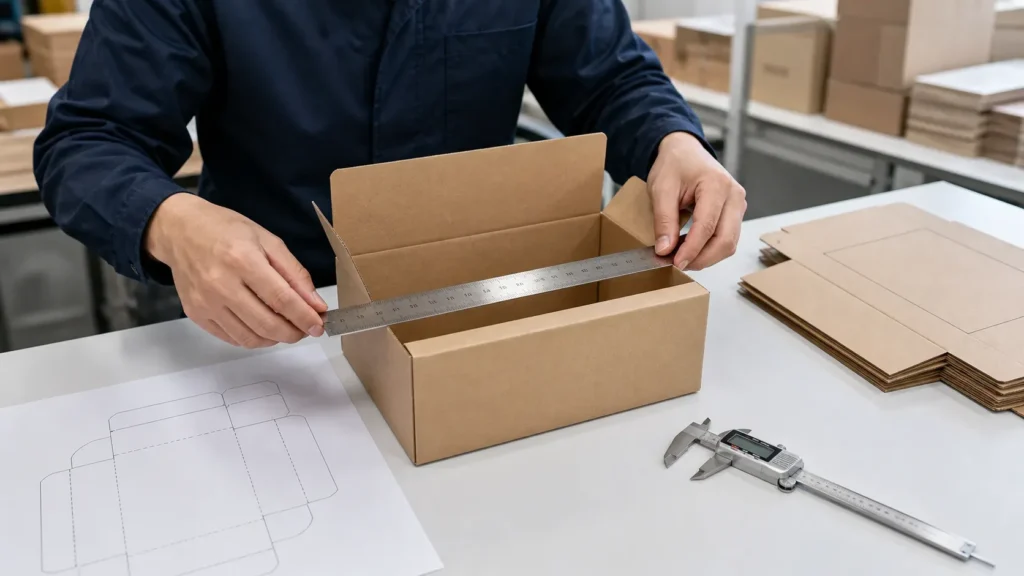
| Width or size tolerance | Dieline dimensions must match approved structural drawing. | Measure with calibrated caliper on die-cut sample. | Tolerance drift causes assembly fit failure. | Request pre-production sample with dimension inspection report. |
| Finish or surface effect | Confirm finish type, gloss level, and coating specification. | Inspect finish swatch under standard lighting conditions. | Unmatched finish leads to package rejection. | Request finish swatch and approve before production. |
| Artwork or logo file | Artwork must be high-resolution with correct color profile. | Print proof to verify color accuracy and registration. | Blurry or misaligned print causes reprint delay. | Submit digital proof for buyer approval. |
The RFQ should also cover sample approval: Sign off sample and confirm production start.
Size, bleed, fold lines, cut lines, and glue areas
Check the print file and packaging dieline handoff checklist before sampling physical sample against the dieline details that affect structure and quote accuracy requirement, dieline, material specification, and product fit; record the accepted tolerance for production QC.
How dieline changes affect sampling
Keep the print file and packaging dieline handoff checklist before sampling measured sample, dieline, and packing assumption in one approval record so reorder dimensions do not drift after the first production run.
RFQ checkpoint
Align the specification, sampling, production, quality, and quote handoff details before sending print file and packaging dieline handoff checklist before sampling for review.

Artwork file checks for custom paper packaging
- Logo, fonts, resolution, color mode, and version control Design agency or in-house designer; file named with version date and suffix Logo update, font substitution, color mode switch, or file resubmission without version log Prepress rework, plate remake, or resampling if file does not meet the production resolution required by the printer, CMYK, or embedded font specs Request PDF proof with dieline overlay and confirm version number; sign off within agreed response time
- Print areas for inside, outside, and flap artwork Packaging designer or buyer; dieline file (die-cut template) must match approved sample dimensions Structure modification, flap fold change, or addition of inside print area after sampling Dieline recut, printing plate realignment, or costly resampling if inside/outside overlap is incorrect Verify dieline matches final box dimensions; mark safe zones and bleed; sign structural proof before print run
- Quality control the production QC team; inspection checklist per product family (paper boxes, bags, etc.) Color deviation > buyer-approved color tolerance, misregistration, coating defect, or substrate variance from approved sample Hold production at press check; reprint or rework defective units; additional QC round if nonconforming Request pre-shipment inspection report and photos of press sheet; approve or reject within agreed response time
- Lead time supplier production planner; supplier-confirmed lead time after all specs, artwork, and sample are confirmed Artwork revision after sample approval, material change, or addition of new finishing (e.g., foil stamping) Production slot pushed out; expediting fee may apply if new timeline is shorter than standard lead time Confirm final artwork freeze date with planner; agree on delivery window before sample sign-off
Keep these checks in the same approval record: the risk is that Buyer decision-maker; sample sign-off is final approval gate before mass production Undocumented change request after sample approval, verbal approval without written confirmation Unplanned rework, material waste, or shipment delay; the supplier may require a new sample cycle Use written approval (email or portal) for every sample iteration; document all changes in change log; Buyer project lead; responsible for closing each checklist item before production release Missed deadline for proof sign-off, incomplete QC report review, or unapproved dieline change Production hold; factory cannot proceed to print without all checklist items closed; may incur storage fee Assign one person to track checklist; confirm approval via signed document or system status update.
The written approval record should cover logo vector file, embedded fonts, the production resolution required by the printer, CMYK, and final version number. Verify dieline includes bleed and safe zones for all print surfaces. Ensures artwork aligns correctly on each panel without cutoff. Agree on QC checkpoints: raw material, print proof, sample, final batch. Catches defects early; reduces scrap and rework costs. Request press-side color measurement report at setup.
Review custom paper packaging before sending the RFQ.
Finish-layer handoff for foil, spot UV, embossing, or lamination
- Spot UV, foil, or embossing areas marked with spot-color swatch and vector mask in a separate layer. Prevents misregistration and ensures finish aligns with dieline cut lines.
- Confirm that the finish specification applies to the entire product family (e.g., same dieline for all SKUs). Avoids separate setup fees and rework for each SKU variation.
- List all finish specs: type, coverage area, color (Pantone reference), gloss level, and thickness (e.g., the approved UV coating). Standardizes supplier interpretation and avoids ambiguous verbal instructions.
- State the project order quantity and confirm the MOQ in the quote. Finishing setup costs often spread across quantity; low qty may increase per-unit cost. Order 500 custom paper boxes with embossed logo.
Keep these checks in the same approval record: production lead time should be confirmed after specifications, artwork, sample requirements, and order quantity are fixed. Finishing adds additional process time; schedule accordingly. Identify cost drivers: number of finish types, coverage area, complexity of registration, and order quantity. Helps buyer prioritize finish choices within budget and compare supplier quotes accurately. Spot UV on full front vs. small logo: full coverage usually costs more.
Approval change-control checklist before sampling
- Final print file approval authority and sign-off requirement Brand owner or project lead; version number tracked in artwork log Any revision after final approval updates file version and resets check Production held until signed-off version received; sample delay risk if late Confirm named approver and version before file handoff to factory
- Changes that reset sample, cost, or timing assumptions Design team or buyer; revision date and change description recorded Structural, artwork, material, or finish changes after approval Requires new quote and sample; lead time resets to supplier-confirmed lead time Flag any change as reset event; request updated timeline and cost
- Quality control checks before sampling QC team or designated inspector; checklist version and date Failed check or tolerance deviation requires re-approval and rework QC report issued; non-conforming items stop production until corrected Review QC checklist; confirm pass criteria and tolerance limits before sample
- Lead time approval and tracking Project manager; lead time commitment version and baseline date Any change to specifications, artwork, or sample requirements lead time confirmed after final specifications and sample approval resets upon confirmed changes Document lead time baseline; monitor change triggers and update schedule
Keep these checks in the same approval record: approval risk assessment Risk owner; assessment version and date of review Unapproved changes or missing sign-offs from key stakeholders May cause production halt, rework, or non-compliant output Identify and mitigate high-risk items before final sign-off; Buyer follow-up actions Buyer or procurement team; follow-up date and escalation point Pending approvals or overdue checkpoints on the change control list Delays if buyer action missing; factory holds production awaiting input Set follow-up schedule; escalate overdue items to approver.
Supporting evidence should address designated approver(s) for the final print file and dieline. Prevents version confusion and ensures the factory receives the correct master file. File modifications that trigger a requote or lead-time adjustment. Avoids unexpected cost or delay after sampling begins. Required QC checks before sample production. Ensures the sample matches the approved file and substrates meet specifications.
Review Zhypacking before sending the RFQ.
Where to send detailed dieline questions
- Provide dieline in editable vector format (AI/PDF) with cut, fold, and bleed layers. Avoids prepress delays and ensures accurate structural quoting from supplier. Include dimensions, material thickness, and finishing zones in separate layers.
- Verify product dimensions, material grade, thickness, and finish type in RFQ. Specs directly impact structural integrity, print registration, and unit cost. For paper boxes, specify flute type, GSM, and coating (matte/glossy). Supplier may assume standard specs that do not match product requirements.
- Document quantity per SKU and confirm the MOQ in the quote. Quantity influences unit cost, tooling amortization, and production schedule. For custom paper boxes, MOQ confirmed in the RFQ; larger orders reduce per-unit cost.
Keep these checks in the same approval record: production lead time should be confirmed after specifications, artwork, sample requirements, and order quantity are fixed. Sets delivery expectations and production capacity planning for buyer. Lead time starts after artwork approval and sample sign-off. Cost driven by material, quantity, print finishes, structure complexity, and die tooling. Identifies where to negotiate or optimize to stay within budget. Die-cutting tooling is a one-time cost; high-volume orders spread it per unit.
Move the approved print file and packaging dieline handoff checklist before sampling sample into a production handoff that lists the final route detailed dieline questions to the custom packaging service page files, material, structure, print, finish, packing, QC checkpoints, and schedule basis.
In conclusion
A rigorous print file and dieline handoff checklist is more than a formality—it directly determines whether your custom packaging project stays on schedule and within budget. By confirming die-cut tolerances, color mode, bleed, and layer structure before sending files to the factory, you eliminate the most common causes of prepress rework and sampling delays. For buyers working with Zhypacking, this checklist aligns with a production workflow that begins only after specifications, artwork, and sample requirements are confirmed, with a lead time confirmed after final specifications and sample approval and a MOQ confirmed for the exact structure, finish, and quantity. The cost and risk implications are clear: an incomplete handoff can trigger additional tooling charges, missed production slots, or mismatched print results, while a validated file set enables precise quoting and faster sample approval.
To move forward with confidence, ensure your dieline and print files match the supplier’s manufacturing specifications exactly—including substrate, finishing, and structural requirements. Once your files are confirmed, your buyer follow-up is to validate the spec with a formal sample order, verifying that every detail from crease position to color match meets your quality standard before mass production begins.
To validate the spec, visit packaging dieline and custom packaging specs and confirm the final specification, quote assumptions, sample approval, QC evidence, approval risk, and supplier follow-up before bulk order.
Print file and packaging dieline handoff FAQ
Which artwork files and logo details should buyers include in the RFQ?
Send the editable artwork file, a PDF proof, the dieline with cut, crease, bleed, glue, and safe-zone marks, finish layers, barcode position, copy version, and any color target. The supplier should confirm that the files match the intended structure before sampling starts.
What sample approval proof should buyers request before producing print file and packaging dieline handoff checklist before sampling?
The buyer should name one artwork owner and one packaging or operations approver, while the supplier should confirm prepress and structural feasibility. Sampling should not start until both sides are looking at the same dated file version.
How can buyers reduce color or finish surprises?
Provide a color target, Pantone or brand color notes when needed, finish maps for foil, embossing, spot UV, or lamination, and the expected substrate. Request a proof or sample on the planned material before approving production.
Ask whether the quoted quantity, sample quantity, and reorder quantity use the same minimum order basis, and record any price tier or bulk-order condition.
Ask the supplier to confirm production lead time after specifications and sample approval are fixed, plus the date when packing and delivery handoff can start.
The buyer should ask which material, print, finish, setup, freight, packing, or reorder assumptions change the quote so each supplier prices the same requirement.
Procurement note: Send product size, finished box size, material target, dieline status, quantity, and packing method so print file and packaging dieline handoff checklist before sampling can be checked before sampling. Contact the team.

Ask a Packaging Question