
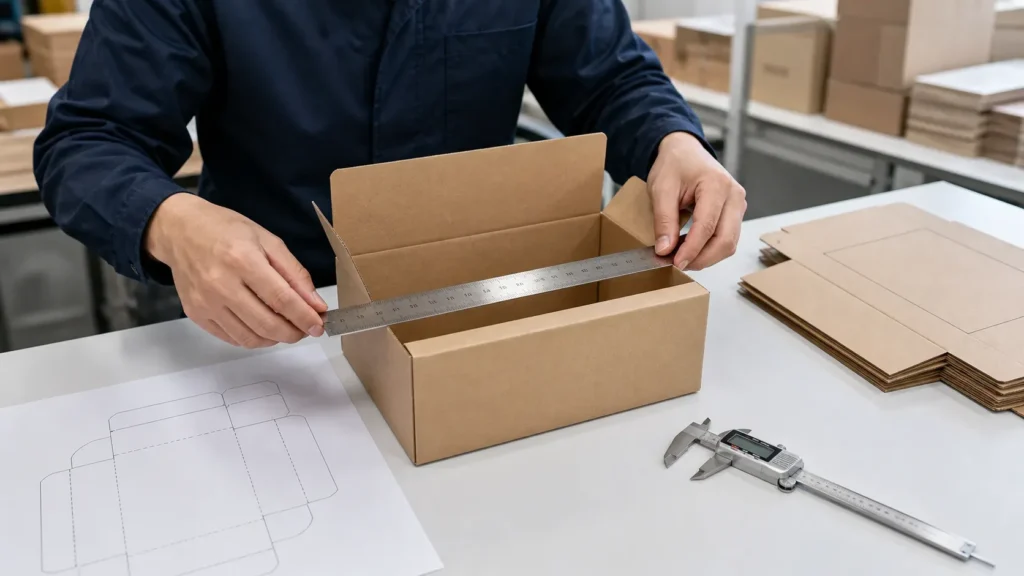
Direct answer: Send inside dimensions, board thickness, insert and closure allowances, and the measurement unit with the quote request, then approve a dimensioned drawing or sample before bulk production.
Measurement mistakes that change custom box quotes
| Requirement | Factory control | Evidence to verify | Order risk | RFQ follow-up |
|---|---|---|---|---|
| Sample approval | Pre-production sample sign-off before bulk run | Compare physical sample to approved artwork and dimensions; retain signed copy | Mass production deviates from agreed spec; rework costs and delays | Request pre-production sample; approve in writing before production starts |
| Material / substrate | Incoming material certificate and mill test report on file | Verify GSM, caliper, and flute type against RFQ; perform grammage check | Substituted lower-grade board reduces box strength and print quality | Request material data sheet and physical swatch; confirm substrate grade in RFQ |
| Packing format | Bundle count, pallet pattern, and stretch-wrap tension per packing spec | Inspect first pallet: count bundles, measure pallet footprint, check wrap integrity | Incorrect pack format causes line stoppage or damage during transit | Define bundle quantity and pallet layout in RFQ; approve photo of first pallet |
Read the rows as one approval sequence for this order. Start with sample approval; use the risk and buyer-action columns to decide whether its evidence is sufficient. Verify it with the inspection method and approval evidence recorded in the table.
Keep the supplier response, marked sample, and approval owner for box measurement mistakes under the same revision number. If any proof conflicts with the approved record, hold the quote, sample, or production release until the supplier explains the deviation in writing. Before closing the checkpoint, reconcile the latest drawing, sample, quotation, and approval comments, identify which record controls if they disagree, and document the resolution. Carry the signed table into the purchase order and production handoff so the same checks support quote comparison, sample approval, shipment release, and later reorders.
Questions to confirm before ordering:
- What internal dimensions do you use for the product cavity? Internal dimensions determine whether the product fits securely without shifting. A mismatch between internal and external specs can inflate material cost or cause damage during transit. Supplier provides separate internal and external measurements with a stated wall thickness or flute type. Approving a quote based on external dimensions alone may lead to a box that is too tight or too loose, causing returns or repackaging costs. Request a dimensioned drawing or sample before approving the production spec.
- How do you verify that the stated dimensions match the actual production run? A quote based on one set of measurements can drift during die-cutting or folding. Without a verification step, you may receive boxes that do not fit your product or automation line. Supplier describes a first-article inspection or in-process check using calibrated rulers or templates. Accepting a quote without a verification method can result in a full batch that fails fit tests, delaying your launch. Add a dimensional check to your sample approval form and require a sign-off before bulk production.
- Do you calculate the quote based on the blank size or the finished box size? Blank size determines material usage and waste. A quote based on finished size may hide extra material costs or lead to a surprise price increase at reorder. Supplier shares the blank dimension and explains how they account for flaps, glue flaps, and waste. Approving a quote without knowing the blank size can lock you into a price that changes when the supplier recalculates material yield. Ask for the blank layout and material yield percentage before signing the quote.
Most measurement mistakes appear during sample approval or first bulk run. A box that fits the product loosely or jams on the packing line signals an internal dimension error. Stacking collapse or pallet overhang points to external dimension or flute direction issues. Catching these early avoids rework and keeps your quote accurate.
Mistake 1: sending product dimensions as finished box dimensions
- Box arrives too large, causing product shift and damage during transit. Finished box external dimensions were used as internal specs, leaving excessive void space inside the custom packaging. Measure the box internal depth and width with calipers. Confirm they match the product dimensions plus agreed tolerance. Approve a revised spec sheet that lists internal dimensions only, and request a new sample before bulk production.
- Multiple quote revisions needed because box dimensions keep changing after sample approval. No written approval gate exists for internal vs. external dimension handoff between buyer and supplier. Review the approval email or sample sign-off form. Verify it states 'internal dimensions' and matches the product fit test. Shortlist suppliers that require a signed dimension checklist before quoting, and keep the marked sample as the approval record.
- Supplier capability is unclear for tight-tolerance boxes needed for fragile items. The RFQ did not specify internal dimension tolerance, so the supplier used standard allowances that increase cost or risk. Ask the supplier for their standard internal dimension tolerance in mm. Compare with your product's clearance requirement. Document the required tolerance in the RFQ and confirm the supplier's capability to hold it before ordering custom packaging.
- Supplier quotes based on product dimensions, not finished box internal dimensions. Boxes arrive too tight or too loose, causing product damage or rejected shipments. Send a physical product sample and request a box dimension proposal before quoting. Supplier's dimension worksheet showing internal length, width, and depth for the product. Compare the worksheet against the product sample and approve dimensions before production.
- No sample approval step for internal fit before bulk production. Bulk boxes may not fit the product, leading to costly rework or returns. Require a pre-production sample with the actual product inserted for fit check. Photo or video of the product inside the sample box with measurement callouts. Document the fit approval in writing and keep the approved sample as a reference.
- Supplier uses external box dimensions for custom packaging quotes without clarifying internal space. You may pay for oversized packaging or get boxes that don't close properly. Ask the supplier to confirm internal dimensions and wall thickness separately. A dimensioned drawing or spec sheet showing internal vs external measurements. Verify the drawing against your product and sign off on internal dimensions only.
Correct dimension set to submit
Ask your supplier to measure the product first, then design the box internal dimensions around it. Provide a physical product sample or a detailed 3D model. This ensures the custom packaging quote reflects the true fit, not an assumption. Always request a dimensioned drawing before approving the quote to avoid costly mistakes.
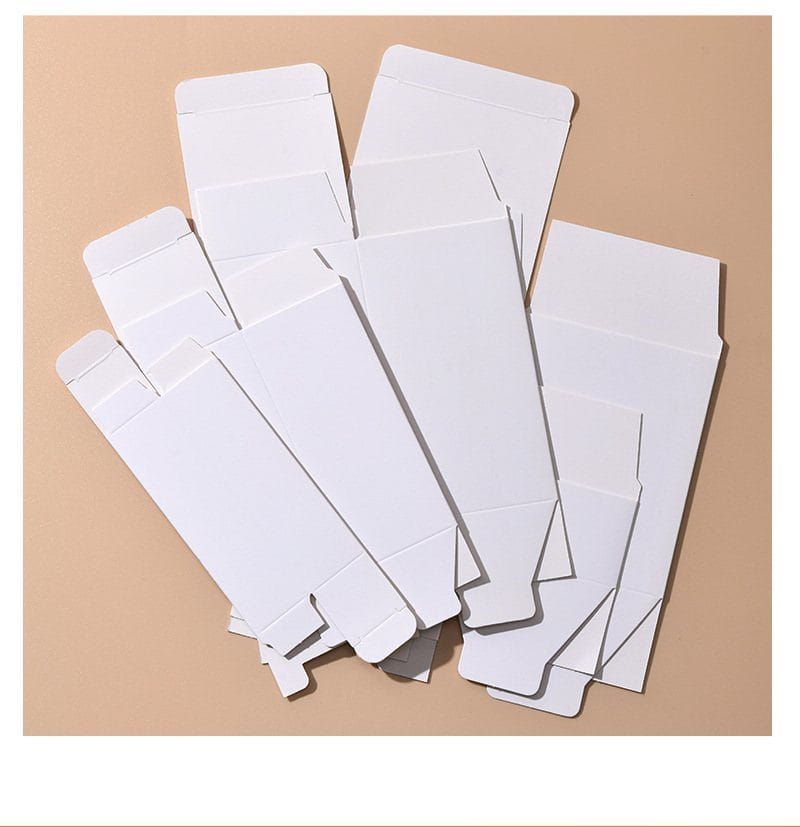
Mistake 2: ignoring board thickness, inserts, or closure space
Define the requirement and success criteria
At the process checkpoint, the quote request must include a clear specification of board thickness, insert dimensions, and closure allowances. Without these, the quote assumes standard values that may not match your product, leading to cost overruns or production delays.
- Specify board thickness (e.g., E-flute, B-flute) and tolerance to avoid box size deviations.
- Define insert dimensions and material (e.g., corrugated dividers, foam) to prevent fit issues.
- Include closure space (e.g., overlap for tuck-end boxes) to ensure proper sealing.
These specs directly impact cost, as thicker board or custom inserts increase material use. Production risk rises if tolerances are ignored, causing rejects per ISO 2859-1 sampling. During quote request handoff, confirm that the supplier’s quote accounts for these factors to avoid change orders.
Mistake 3: mixing retail, mailer, and shipping box assumptions
Before approving a mixed-SKU packaging order, reconcile each SKU's product size, intended box function, board construction, and fit evidence on one signed schedule; any row without a matching sample remains on hold.
- Document the box type for each SKU: Specify retail, mailer, or shipping box per SKU Confirms box type and internal/external dimensions Mixing types inflates quote or causes structural failure Approve box type before sample production
- Verify dimensional tolerances per box type: Provide max product dimensions and desired fit allowance Returns tolerance range and board thickness adjustment Wrong tolerance leads to product damage or excess void fill Check tolerance against your product fragility
- Confirm lead time for each box type: Request separate lead time for retail, mailer, and shipping boxes States standard 15–30 working days after spec confirmation Shipping boxes often have faster lead time; mixing delays approval Align production schedule with your launch date
- Inspect sample against box-type assumptions: Send product sample for fit test in each box type Provides fit report and photos of product inside box A mailer box used as a shipping box may collapse in transit Sign off on sample or request revision
- Lock specifications for bulk run: Confirm final box type, dimensions, and board grade per SKU Issues production spec sheet for approval Unclear specs cause rework and missed delivery window Place bulk order with confirmed spec sheet
Correct structural allowance to document
Treat each box type as a separate specification line item. Document internal and external dimensions, board thickness, and flute direction for retail, mailer, and shipping boxes separately. This prevents quote errors from mixed assumptions and ensures accurate pricing for custom packaging solutions. Verify each dimension against the product, cushioning, and shipping constraints before approving the sample.
Fix priority matrix for box measurement errors
| Issue | Buyer impact | Urgency | Fix owner | Follow-up |
|---|---|---|---|---|
| Sending product dimensions as finished box dimensions | Quote based on wrong internal size, leading to extra board cost or box that does not fit | High | Buyer (specify internal vs external in RFQ) | Require supplier to measure product first, then design box internal dimensions |
| Ignoring board thickness in dimension math | External dimensions exceed carrier limits or warehouse slot, causing dimensional-weight penalties | High | Supplier (confirm board thickness in RFQ) | Document board thickness and flute type in every spec line item |
| Mixing internal and external measurements across box types | Pallet count and stacking plan fail; reorder must re-approve dimensions | Medium | Buyer (approve each box type as separate spec line) | Treat each box type as a separate spec line; document internal and external dimensions |
| Not confirming measurement unit (mm vs inches) with supplier | Quote mismatch by factor of 25.4; sample approval delayed | Medium | Buyer (state unit in RFQ and sample approval form) | State measurement unit in RFQ and sample approval form; verify on first sample |
How the matrix is used
Use this matrix during quote request review and before sample approval. Each row names a common measurement mistake, its cost or lead-time impact, who must fix it, and the next verification step. The urgency column tells you which errors to correct first. For example, internal versus external dimension mismatch is high urgency because it changes the entire quote.
Prepare box dimensions for a cleaner quote
At the point where product dimensions are first submitted for a custom packaging quote request, the required output is a complete dimension sheet that accounts for board thickness, inserts, and closure space. Without this, quote assumptions shift and final box dimensions can differ, leading to cost overruns or production delays.
What the dimension sheet must carry
- Product dimensions (length, width, height) in millimeters or inches, with tolerances.
- Board thickness and type (single-wall, double-wall).
- Insert details: material, thickness, and number of compartments.
- Closure allowance (for tuck flaps or glue flaps).
- Finished box dimensions calculated from the above, not just product size.
How to check the sheet before sending
Before sending to the factory, verify that the sheet includes all five elements above. A common mistake is listing only product dimensions, which forces the factory to guess board thickness and closure space, changing the quote. Use this table to cross-check:
| Element | Example | Risk if missing |
|---|---|---|
| Product dimensions | 200x150x100 mm | Box too small or large |
| Board thickness | Single-wall | Quote assumes thinner board |
| Insert details | Foam insert | Box interior too tight |
| Closure allowance | Tuck flap | Box won’t close properly |
| Finished box dimensions | 210x160x110 mm | Production rework |
After the sheet passes this check, the factory can produce a cleaner quote with accurate material costs and MOQ. This reduces the risk of quote changes during sample approval and ensures smoother handoff from quote request to production.
Source check: ISO 2859-1 sampling inspection standard.
for the current product, use custom retail packaging to align the applicable specification, proof record, supplier responsibility, and quote request handoff before comparing quotes.
In conclusion
Every measurement mistake outlined above directly alters your custom packaging quote—by inflating material cost, extending lead time, or introducing quality risk that surfaces only at sample approval. The sourcing decision therefore hinges on how thoroughly you compare the spec sheet you submit against the quote you receive. Before you shortlist a supplier, validate that your inside dimensions, board thickness, and finished box tolerances are documented on the quote request; then check that the quoted price, MOQ, and production timeline reflect those exact figures. Approve a sample only after verifying that the physical box matches your submitted dimensions within the agreed tolerance, and that the supplier has provided clear evidence of their measurement process. This disciplined handoff from spec to quote to sample is what separates a predictable packaging project from one that incurs hidden costs and delays.
To request a quote for this sourcing program, use paper box size options to confirm the final specification, quote assumptions, sample approval, QC evidence, approval risk, and supplier follow-up before bulk order.
Box measurement mistakes that change packaging FAQ
Should buyers send inside dimensions or outside dimensions for a custom packaging quote?
Always send inside dimensions (the clear space your product must fit into) because the supplier adds board thickness and flute allowance to calculate the outside dimensions for shipping and material cost. If you send outside dimensions, the quote will be based on a box that is too small for your product, leading to a fit failure and a requote that increases cost and extends lead time. Confirm with your supplier which dimension set they need before submitting your quote request. Ask how QC will check the sample, color, finish, packing, and bulk order.
How do product fit, inserts, board thickness, and shipping protection change box size?
Product fit determines the inside length, width, and depth; inserts add clearance for cushioning and must be specified as separate line items. Board thickness (e.g., E-flute vs. B-flute) directly increases outside dimensions and material cost, while shipping protection requirements may demand double-wall construction or added corner supports. Each change in these variables shifts the quote—document all three in your specification sheet and verify with the supplier before sample approval. Approving the wrong structure or supplier proof can create quality, cost, or delivery problems.
What photos or samples help suppliers quote the right box dimensions?
Provide a photo of the product with a ruler alongside all three axes, plus a short video showing how the product is loaded or oriented. If you have a reference box from a previous order, ship a physical sample to the supplier so they can measure and replicate the internal fit. This eliminates guesswork and reduces the risk of a quote that misses clearance or stacking strength requirements. Ask for a sample, specification confirmation, or QC evidence before approval.
How to measure a box
Measure inside dimensions from the deepest point of each panel, using a rigid ruler or caliper for accuracy: length is the longest side, width is the shorter side, and depth is the vertical distance from the bottom panel to the top edge. Always measure at three points per side and use the smallest reading to ensure your product fits without compression. Record the measurement in millimeters and include board thickness in your quote request so the supplier can quote the correct outside dimensions and material cost. Ask how QC will check the sample, color, finish, packing, and bulk order. Approving the wrong structure or supplier proof can create quality, cost, or delivery problems. Ask for a sample, specification confirmation, or QC evidence before approval.
quote request handoff: Send Specs for Review.


Ask a Packaging Question