

Custom mailers disappoint when brands treat them as printed posters. Board grade, size family, and open method decide damage rate and pack-out cost more than ink coverage.
Choose structure for the product and route first, then place artwork and lock reorders with revision control.
- Key takeaways: size the mailer to the packed product, not the product alone.
- Protection choices (board, insert, void fill) come before print choices.
- Keep repeat orders on one controlled revision set.
- Put size family, board, and sample plan into the first RFQ.
Direct answer: Size the mailer to the packed product, not the product alone, and define finished inside dimensions, board build, insert or void fill, opening, closure, print, pack-out, and acceptable fit before quoting. Compare protection, presentation, labor, packed volume, and current carrier billing. Reorders should match the controlled material specification and approved revision unless a change is reviewed.
Method and limits: ISO 3037:2022 covers edgewise crush resistance of corrugated fibreboard, and ISTA lists procedures for defined distribution contexts. UPS’s size and weight guide illustrates carrier-specific dimensional billing. None guarantees mailer performance or savings for this order; verify the loaded pack and current shipment terms. Reviewed 20 September 2026.
When a Custom Mailer Box Is the Right Shipper
Pick a custom mailer when brand exterior and exact fit matter more than pure commodity shippers.
- Good fit DTC brands with stable SKU sizes and unboxing goals.
- Weak fit Highly variable product sizes or pure bulk B2B freight.
- Trade-off Brand and fit versus setup, sampling, and inventory of sizes.
If protection alone is the goal, a plain RSC with a label may win on speed.
The checks in this guide follow the order our sample room applies them: fit and protection first, then presentation, then repeat-order control. When two mailer options both fit, a head-to-head trade-off on DIM weight, damage exposure, and unboxing moment settles the choice — supplier references such as custom mailer box options present the same decision inputs.
Before any of that, put the hard parameters on paper: inner dimensions, board grade and flute, weight limit, and closure style. Quotes compared without those parameters are not comparable.
For when a Custom Mailer Box Is the Right Shipper, record the approval risk if the evidence does not match the approved requirement before the buyer signs the approval record.
Balance Protection and Presentation
Every protection choice below has a presentation cost, and every presentation choice has a protection cost — the balance is a specification decision, not a styling one.
| Choice | Spec to confirm and acceptable range | Verification check | approval risk if skipped | buyer follow-up |
|---|---|---|---|---|
| Right-size mailer | Inner dims per SKU family with an acceptable fit range stated | Measure the packed product; run a rattle check on the sample | Higher DIM weight or product movement damage in transit | Freeze the size family before quoting |
| Higher board grade | Board grade and flute choice matched to weight and stack load | Ask which grade the quote assumes; inspect a crush sample | Corner crush and stack failure that cost more than the upgrade | Approve board grade in writing before print |
| Insert or void fill | Insert material and retention per product surface | Pack-out sample check with the real product | Scuff and shift complaints after delivery | Confirm insert spec with the sample plan |
| Inside print | Print coverage and ink adhesion on the chosen board | Review an inside-print proof on production stock | Rub-off or show-through on the unboxing surface | Approve inside print as a separate line item |
Whatever balance you choose, verify it on sampled lots rather than single boxes; the ISO 2859-1 sampling inspection standard is the usual reference frame for lot-level acceptance decisions.
For balance protection and presentation, see packaging dieline and custom packaging specs.
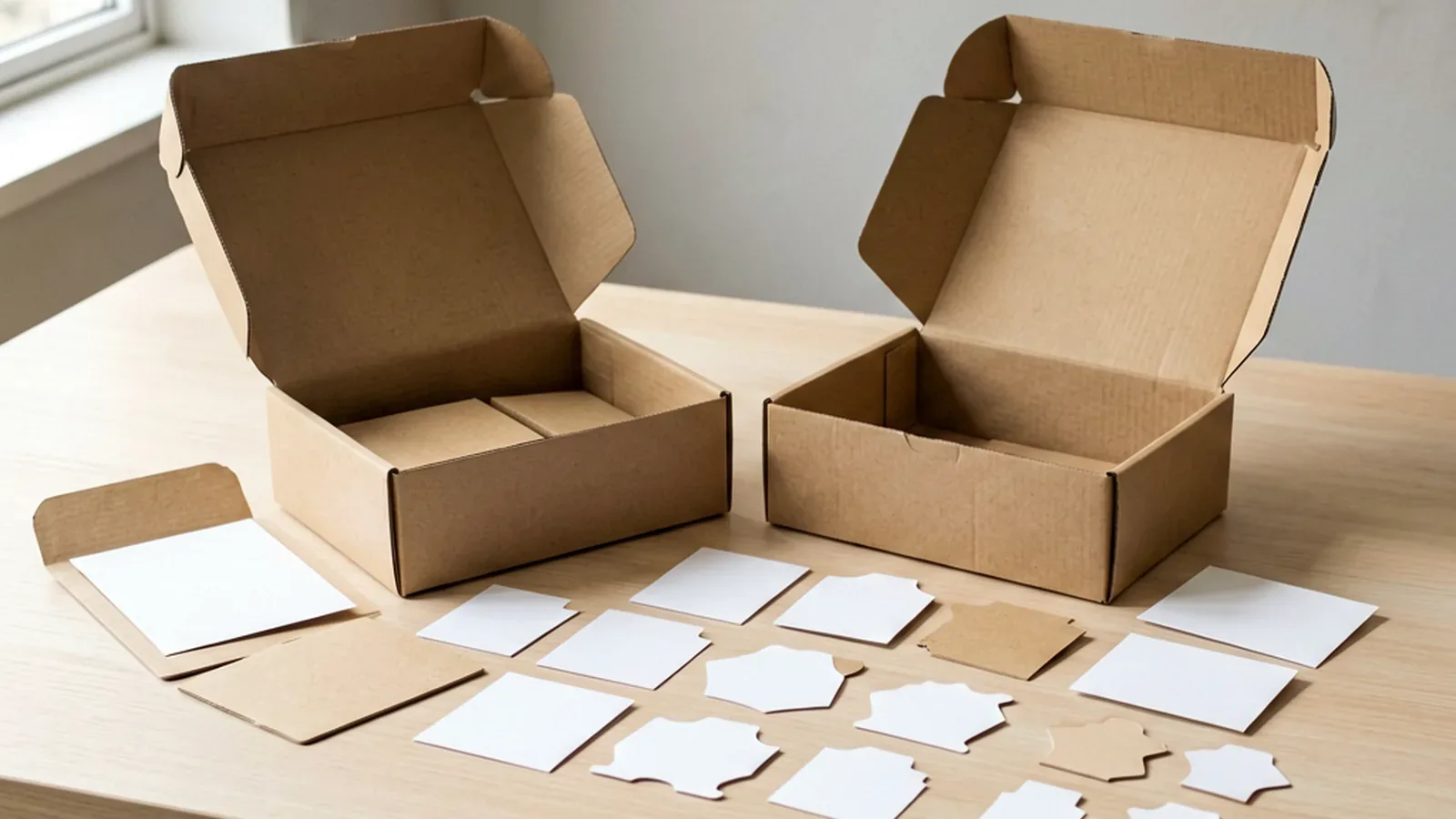
Where Artwork Should Live on the Mailer
Place artwork where ship abrasion and open method allow:
- Primary brand face away from high-scuff edges when possible.
- Inside print only if unboxing value beats cost.
- Barcodes/shipping labels planned so they do not cover critical brand marks.
- Revision ID on every print file used in bulk.
Approving art on thin white stock then bulk on a different board is a common color and strength failure.
Supplier guides, for example low-MOQ custom mailer options, confirm the same layout habit: keep critical artwork away from crush and fold zones.
For where Artwork Should Live on the Mailer, name the inspection record and pass/fail owner; record whether the buyer follow-up is quote revision, sample approval, shortlist, or production release before the buyer signs the approval record.
For artwork placement on the mailer, see custom printed tissue paper products.
How to Keep Repeat Mailer Orders Consistent
Reorders stay stable when board mill, structure, size family, and artwork revision are frozen on the PO.
- Retain sample with IDs.
- Retest when product weight or size mix changes.
- Do not silent-substitute board to hit a price.
A cheaper reorder that fails ship tests is not a saving.
Factory-side product pages, such as custom mailer box manufacturing options, show which parameters factories hold constant between runs — board source, print spec, and die revision.
For keeping repeat mailer orders consistent, see custom packaging solutions.
Move Mailer Checks Into the RFQ
- Size family inner dims per SKU plus the fit range you accept.
- Board and style grade, flute, and mailer style with closure type.
- Print and inserts print surfaces, insert or void-fill plan.
- Quantities and samples volumes, sample rounds, and ship assumptions.
Align mailers with retail gift lines under one packaging program when brand color must match across formats. A factory quotes faster and more accurately when every field arrives labeled, and the risk of a wrong-die restart drops with each parameter confirmed in writing.
Write the insert decision into the specification before requesting quotes: an insert changes the dieline, the sample scope, and the unit price, so two mailer quotes are only comparable when both suppliers priced the same insert assumption. At Zhypacking a sample typically takes about 7 days after structure and specification are confirmed, and standard production runs 15-30 working days once artwork and samples are approved; final timing still follows the actual RFQ.
In conclusion
For custom mailer boxes, the next procurement action is a written RFQ and sample approval record, not only a preferred style or unit price. Confirm the specification, MOQ assumption, artwork version, supplier capability, sample approval method, QC checkpoint, approval risk, and quote follow-up before bulk production.
If any material, structure, logo, finish, packing detail, or supplier proof changes, ask the supplier to update the quote and sample record before approving production.
Custom Mailer Boxes FAQ
One mailer size for all SKUs?
Simple ops, higher DIM. A small size family usually wins on landed cost if pack rules are clear.
Do I need inside print?
Only when unboxing value is worth it. Inside print does not fix weak board.
How many sample rounds?
Budget structure and decorated checks when board or size is new to your program.
What belongs in the first RFQ?
Inner size, board, style, print coverage, insert plan, volumes, and ship expectations.
For custom mailer boxes FAQ, see paper packaging quality control.
RFQ handoff: For custom mailer boxes, share product size, material, artwork, quantity, sample need, packing method, and deadline so the RFQ can be reviewed before sample approval. Send Specs for Review.
If this stage leads into that check, compare it against our mailer Boxes With Inserts: Fit, Protection, and Unboxing Checks.

Ask a Packaging Question