
Planning corrugated shipping boxes starts with the product dimensions and distribution route, because both affect board, structure, print, insert clearance, packing, and the sample used to release production.
This packaging guide turns those choices into a dieline brief, sample sign-off record, and quote checklist for comparing suppliers on the same specification.
Direct answer: Use corrugated shipping boxes only after its specification, application fit, sample route, quantity rule, and supplier exceptions have been confirmed in writing.
What buyers should confirm before choosing corrugated shipping boxes
| Requirement | Factory control | Evidence to verify | Order risk | RFQ follow-up |
|---|---|---|---|---|
| Sample approval | Supplier holds pre-production sample for sign-off before bulk run. | Compare sample against approved spec sheet; measure dimensions, board grade, print. | Bulk run may deviate from agreed standard without signed-off reference. | Request physical sample and written approval form before production release. |
| MOQ and order quantity | Factory sets project-level MOQ at 200 pcs unless exception confirmed. | Confirm MOQ in written quote; check if split shipments or trial orders allowed. | Under-ordering may trigger minimum charge or delay; over-ordering ties capital. | Verify MOQ and lead time in RFQ; request tiered pricing for higher volumes. |
| Material / substrate | Supplier certifies board grade, flute type, and grammage per spec. | Request material data sheet; inspect edge crush test (ECT) or burst strength report. | Wrong substrate leads to stack failure, print rejection, or transit damage. | Specify board grade and flute in RFQ; ask for certificate of conformance. |
| Width or size tolerance | Factory controls internal dimensions within the buyer-approved tolerance per ISO standard. | Measure sample across length, width, height; compare to approved drawing. | Oversized boxes waste void fill; undersized boxes damage product or jam automation. | Define acceptable tolerance in spec sheet; approve sample dimensions before order. |
| Finish or color control | Printer uses densitometer and Pantone reference for color consistency. | Hold printed sample against approved color standard under buyer-approved viewing conditions. | Color drift across runs causes brand rejection or reprint costs at buyer expense. | Approve color proof and finish sample; request delta-E tolerance in RFQ. |
Before committing to a corrugated box order, buyers must confirm that every specification—from board grade to dimensional tolerance—is documented in a written RFQ. The approval process hinges on comparing a physical sample against that spec sheet, not on verbal assurances. Without this step, the factory may interpret requirements differently, leading to rejected shipments, rework delays, and unexpected costs. A signed-off sample serves as the binding reference for the entire production run.
The consequence of skipping formal approval is that the buyer bears the risk of non-conforming goods, including dimensional errors, color mismatch, or insufficient stacking strength. To mitigate this, the buyer follow-up is to request a pre-production sample and a written approval form before the factory begins bulk manufacturing. All commercial numbers—MOQ, lead time, and pricing—must be confirmed in the quote request document, not assumed from earlier discussions.
Questions to confirm before ordering:
- What board grade and flute type does your product require? Board grade and flute type determine stacking strength, cushioning, and cost. A mismatch causes box failure during transit or storage. Supplier provides a written spec sheet listing grade (e.g., 200#/ECT-32) and flute (B, C, BC) with edge crush test values. Wrong grade leads to crushed boxes or overpaying for unnecessary strength; no spec sheet means no verifiable standard. Document the board grade and flute in your quote request and request a material certificate from the supplier.
- What is the project-level MOQ for corrugated shipping boxes? MOQ affects order feasibility and unit cost. A supplier with a low minimum allows small-batch testing before bulk commitment. Supplier confirms the project-level MOQ per design in writing, with no hidden setup charges for first orders. Unclear minimum order can lock you into large volumes before verifying quality, or cause unexpected cost per unit. Confirm the minimum order in writing and ask if sample approval counts toward the first production run.
- How does the supplier verify print registration and color accuracy? Print defects like misregistration or color shift ruin branding and require rework. A defined QC method prevents shipment of rejects. Supplier uses a densitometer check on the first run and a visual inspection on all printed panels before packing. No print QC step means you may receive boxes with off-brand colors or blurry logos, delaying your launch. Request a print approval sheet with Pantone references and a signed first-article inspection report.
- What is the standard production lead time after spec sign-off? Lead time impacts your inventory planning and launch schedule. A fixed window (e.g., 15–30 working days) allows reliable forecasting. Supplier states 15–30 working days after specifications, artwork, and sample requirements are confirmed, with no hidden delays for material sourcing. Unclear lead time can cause stockouts or rushed shipping costs; a vague answer signals poor production scheduling. Incorporate the lead time into your order contract and request a production timeline with milestone dates.
- Does the supplier hold ISO 9001 certification, or an amfori BSCI audit report, for quality and social compliance? Certifications verify that the factory follows consistent quality management and ethical labor practices, reducing audit burden. Supplier provides certificate numbers for ISO 9001 and BSCI, with scope covering corrugated box production. Uncertified suppliers may lack process controls, leading to variable quality or compliance issues in your supply chain. Request copies of current certificates and confirm they are valid for the production site you will use.
Use the evidence for what buyers should confirm before choosing corrugated shipping boxes to compare the supplier record with ISO 2859-1 sampling inspection standard before accepting the requirement.
Which damage pattern should Corrugated Shipping Boxes solve
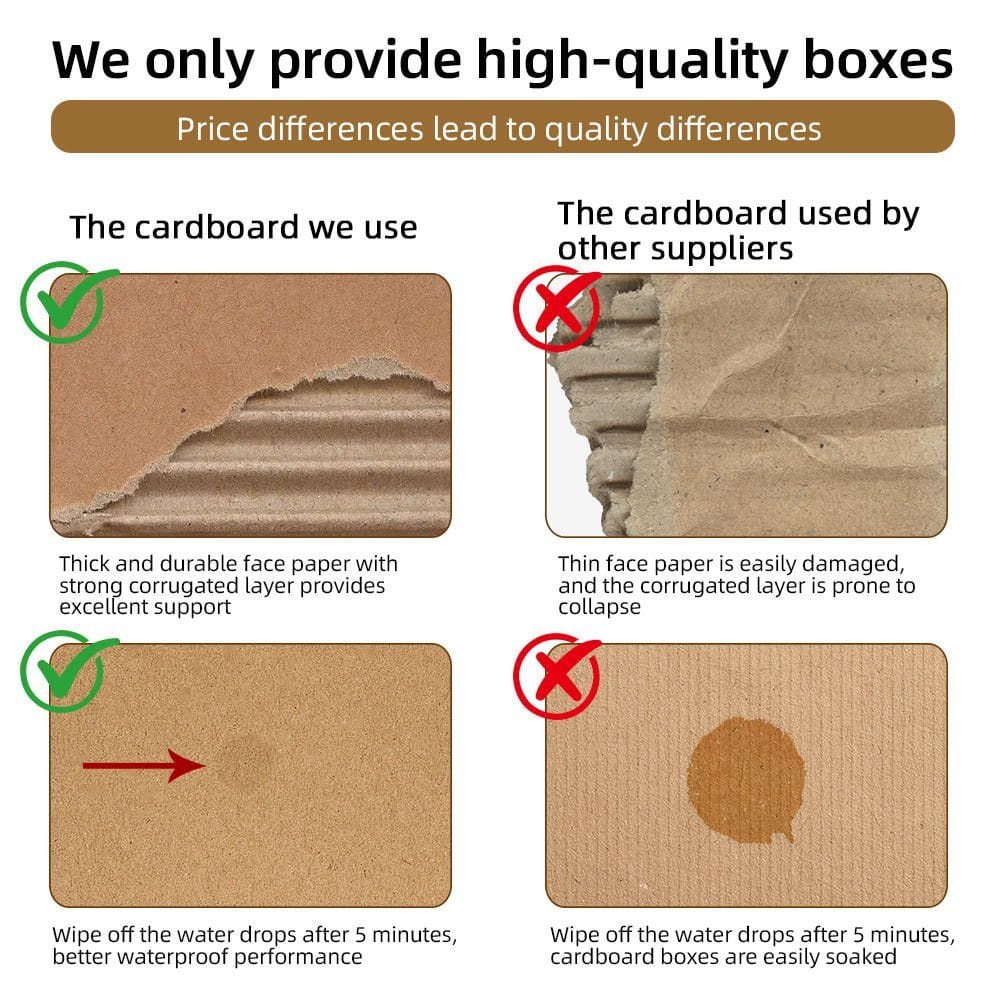
Before you send an quote request, verify the damage pattern your boxes must prevent. A buyer’s drop-test record—for example, a free fall onto a concrete edge—proves the required edge crush test (ECT) value. Ask your supplier: “What is your ECT target for this box grade, and how do you measure it on each production lot?” This question shifts the conversation from generic specs to verifiable factory execution.
Use this checklist during sample handoff:
- Confirm internal dimensions (L×W×H in mm) match your product’s clearance needs.
- Request the supplier’s ECT and burst test results from the same production run.
- Verify print registration and ink adhesion with a tape pull test on the first article.
- Ask for a written statement that the box will pass a drop test at the agreed height on its weakest edge.
If the supplier cannot provide these records, production risk rises. A table like the one below helps you compare options before committing to an quote request.
| Check | Buyer verification question | Factory signal |
|---|---|---|
| Board grade & flute | What ECT does this grade guarantee? | Supplier provides ECT certificate per lot |
| Print quality | How do you ensure ink stays on during transit? | Supplier runs tape pull test on every job |
| Drop test | Can you replicate my drop test? | Supplier shares video or report |
Use this table to structure your quote request requirements. When the supplier answers each question with a verifiable record, you reduce the risk of box failure and avoid costly reorders.
Use the evidence for which damage pattern should corrugated shipping boxes solve to compare the supplier record with Types, Uses and Production of Corrugated Boxes before accepting the requirement.
How to choose the right structure for Corrugated Shipping Boxes
| Option | Best fit | Trade-off | Risk to avoid | Verification | Follow-up |
|---|---|---|---|---|---|
| Single-wall RSC (regular slotted container) | Light to medium-weight e-commerce shipments based on the buyer-provided product weight | Lower material cost but reduced stacking strength for multi-layer pallet loads | Box collapse during transit if combined weight exceeds flute rating | Check edge crush test (ECT) value on supplier spec sheet against your load weight | Request ECT and burst strength data for your specific product weight |
| Double-wall corrugated box | Heavy or fragile items requiring extra puncture resistance | Higher board cost and slightly heavier tare weight per box | Over-specifying adds freight cost without benefit for light goods | Confirm double-wall construction (e.g., BC flute) in writing and measure caliper on sample | Compare freight cost increase against damage reduction for your product |
| Die-cut corrugated box with inserts | Multi-component kits or irregular-shaped products needing snug fit | Higher tooling charge and longer lead time for first production run | Insert design may shift during transit if not tested with actual product | Run a drop test with loaded inserts before approving production | Approve insert layout drawing and request a sample with your product inside |
| Heavy-duty triple-wall corrugated box | Industrial parts or palletized loads exceeding the buyer-provided product weight | Highest material cost and limited availability from standard stock | Box may be too rigid, causing product damage from lack of cushioning | Verify triple-wall grade (e.g., A-flute combination) and request compression test report | Specify internal dimensions and load orientation on the PO |
For single-wall rsc (regular slotted container), a poor decision can mean box collapse during transit if combined weight exceeds flute rating. Ask the supplier to check edge crush test (ect) value on supplier spec sheet against your load weight. Use the result to decide whether this checkpoint can proceed or must stay on hold.
Preserve the single-wall rsc (regular slotted container) decision under one revision number: keep the supplier response, marked sample, approved specification, quotation, and approval owner together. If the evidence conflicts with the approved record, hold the quote, sample, or production release until the deviation is explained in writing. Once the buyer and designated technical authority have accepted the evidence, carry the signed approval record into the purchase order, production handoff, shipment release, and later reorder review so every team works from the same baseline.
What to test before approving Corrugated Shipping Boxes
Approve a corrugated shipping box only after the supplier’s sample passes your defined drop, compression, and print tests—otherwise, reject and request a revised sample before quote request. This decision rule keeps your packaging specification aligned with actual factory capability and avoids costly rework later.
Supplier evidence to request
Before sending an quote request, ask the supplier for a process capability summary that includes their flute lamination method, board grade traceability, and print color management steps. Verify that their standard operating procedures match your required tolerances for dimensions, caliper, and ink adhesion. If the supplier cannot provide documented proof, treat it as a red flag and consider alternative vendors.
Sample approval evidence
When you receive a sample, test it against your agreed acceptance criteria: measure internal dimensions, check flute profile, perform a drop test at a specified height, and run a compression test to confirm stacking strength. Also inspect print registration, color accuracy, and scuff resistance. Keep a signed sample as the reference for production, and record the test results in your approval record.
Reorder control records
For reorders, confirm that the supplier still holds the approved sample and that their production process has not changed. Ask for a lot-specific test report or a declaration of conformity to the original specification. If the supplier cannot provide evidence of consistency, require a new pre-production sample before committing to the order.
Use the table below to structure your pre-quote request verification steps and ensure nothing is missed.
| Checkpoint | What to verify | Pass criteria |
|---|---|---|
| Supplier proof | Process documentation, board grade traceability | Documented and matches your spec |
| Sample approval | Dimensions, drop test, compression, print quality | All tests pass against agreed limits |
| Reorder control | Production consistency, lot test report | Evidence of unchanged process |
After these checks, you can confidently move to quote request with a clear specification and a qualified supplier. For further customization options, see our packaging customization and dieline specs.
How to move Corrugated Shipping Boxes checks into an RFQ
Before you approve a sample, confirm that the supplier’s drop-test result matches your required edge crush test (ECT) value. A buyer verification question such as “What is the ECT rating of the board grade you propose?” ensures the spec is locked before production. Keep the signed sample approval record—include the date, the approved ECT value, and the print color tolerance.
Specification details to confirm
Verify internal dimensions (L×W×H in mm), flute type (B, C, BC), and board grade (single-wall or double-wall). Ask the supplier to confirm the minimum order quantity (minimum order) in writing and whether it applies per SKU or per production run.
Sample approval record
Document the acceptance criteria: drop height, number of drops, and acceptable damage level. Assign an approval owner from your team and require the supplier to provide a signed counter-sample.
Production handoff notes
In the quote request, state that the first production run must match the approved sample within the agreed tolerances. Include a clause for re-approval if board grade or flute type changes.
| Checkpoint | Buyer verification question |
|---|---|
| Board grade & flute | What ECT value does your proposed board achieve? |
| Print tolerance | What maximum color tolerance can you hold? |
| MOQ | Is the MOQ per SKU or per production run? |
After the table, confirm that the supplier’s quality control process includes a documented inline inspection for print registration and slotting accuracy. This reduces production risk and ensures factory execution matches the approved sample.
In conclusion
The final approval for your corrugated shipping boxes comes down to verifying that the supplier’s quoted specifications, minimum order of 200 pcs, and 15–30 working day lead time (after specifications, artwork, and sample requirements are confirmed) align with your damage-prevention requirements and budget. Compare the board grade, flute type, and ECT values against your drop-test criteria, then document the acceptance thresholds before signing off on a sample. Shortlist only those suppliers whose quality control process includes a physical sample match to the first production run, and request a quote that confirms these parameters in writing. This structured handoff from spec validation to sample approval reduces the risk of mismatched box performance and ensures your packaging investment protects the product through the entire supply chain.
To request a quote for corrugated boxes, use corrugated boxes to confirm the final specification, quote assumptions, sample approval, QC evidence, approval risk, and supplier follow-up before bulk order.
Corrugated shipping boxes FAQ
What should buyers confirm before ordering Corrugated Shipping Boxes?
Yes, when you confirm the board grade, flute type, internal dimensions, and ECT value match your shipment weight and stacking needs. Document these specifications in your quote request so the supplier can quote accurately and avoid miscommunication on material strength or box fit.
How should buyers compare MOQ, lead time, and quote terms?
Compare minimum order by asking if the 200 pcs project-level minimum order applies to your box size and print complexity. For lead time, confirm the standard 15–30 working days after specifications, artwork, and sample requirements are confirmed. Request a written quote that itemizes material grade, print coverage, and any insert or finishing costs so you can verify cost drivers before ordering.
What sample, quality, or supplier checks reduce risk?
Reduce risk by ordering a physical sample to check dimensions, board quality, and print alignment against your approved spec. Ask the supplier for a drop-test report or perform your own to verify stacking strength. Before approving the sample, document the accepted standard and keep evidence; then shortlist Xiamen ZHY Packing Co.,Ltd for reliable QC and follow-up on any adjustments.
quote request handoff: Send Specs for Review.
If this stage leads into that check, compare it against our corrugated Shipping Box Strength Checklist for Custom Orders.


Ask a Packaging Question