
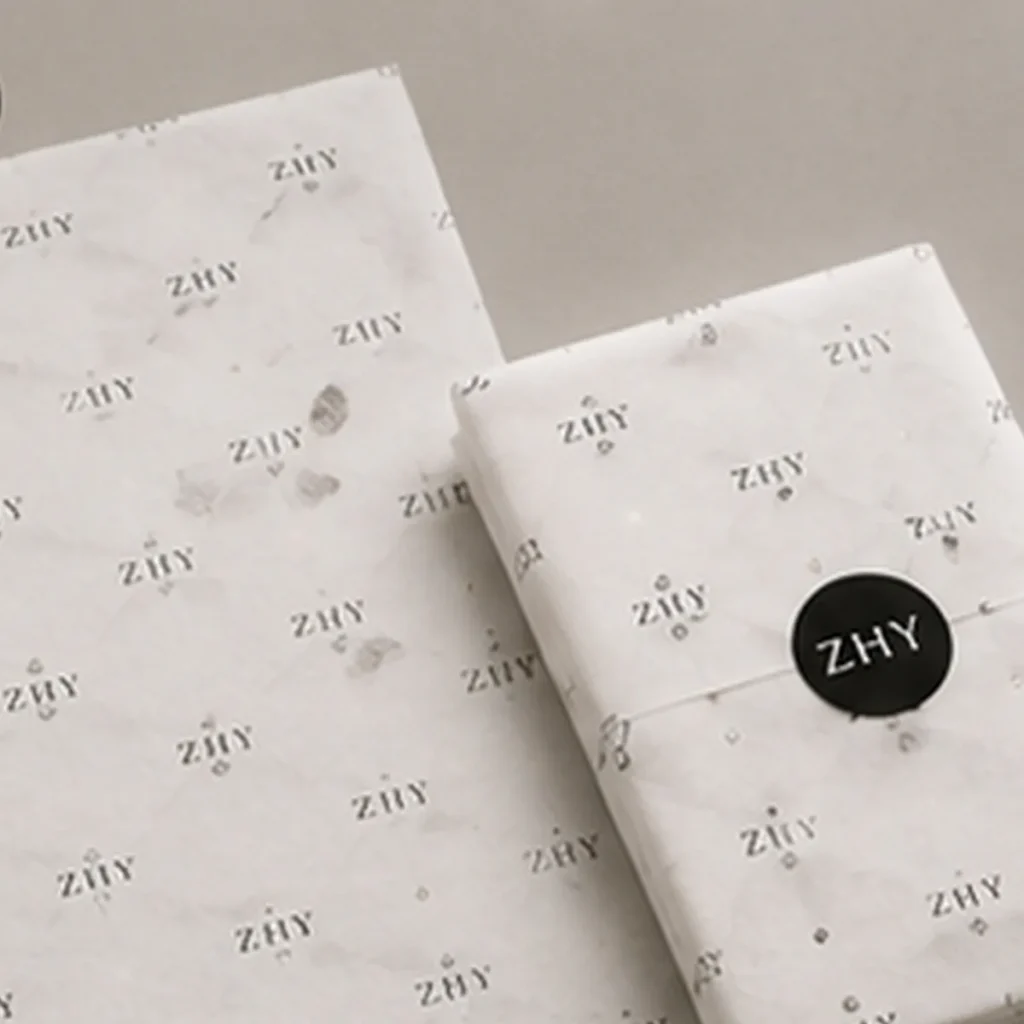
Tissue paper quotes diverge mainly on two inputs buyers rarely state: ink coverage (a repeating small logo costs very differently from an all-over print) and whether the quantity is per design or across all designs. Both change the unit price more than gsm does.
Direct answer: For custom printed tissue paper comparison, buyers should prepare quote-ready specifications before contacting suppliers.
Why two tissue paper quotes for the same job can differ so much
Send the same artwork to three tissue paper suppliers and the unit prices often come back far apart. The usual reaction is to assume someone is padding the margin, but in most cases the suppliers are quoting three different jobs. Custom printed tissue is priced off a short list of inputs, and when a buyer leaves any of them open, each factory closes the gap with its own house standard. One quotes a small repeating logo, another assumes an all-over print. One counts your quantity per design, another spreads it across every design in the order. Neither is wrong against the brief you sent; they are simply not comparable.
This matters more on tissue than on rigid packaging. A folding carton has a dieline that pins down most of the cost. Tissue has almost no structure to constrain it, so the price rides almost entirely on paper weight, print area, colour count, and how the quantity is counted. Those four inputs are also the ones buyers most often leave to the supplier.
The inputs buyers usually leave open
Before comparing anything, check whether your RFQ actually fixed the five items below. If a line is blank, you are not comparing suppliers; you are comparing their assumptions.
| Input | What happens if you leave it open | How to verify it is fixed | Buyer follow-up |
|---|---|---|---|
| Sheet size | Each factory picks a size that nests well on its own parent sheet, so the trim waste (and price) differs | Flat sheet dimensions, plus folded size if you need it delivered folded | Ask the supplier to confirm the size back in their reply |
| Paper weight | Quotes default to the lightest stock that survives handling, which may not survive your shipping | The gsm you need, or describe the use so the supplier can propose one and state it back | Request a physical sample at the quoted gsm before ordering |
| Ink coverage | A repeating small logo and an all-over print can be quoted against the same artwork file | Approximate printed area as a share of the sheet, and whether the design bleeds off the edge | Ask which coverage the quote assumed, in writing |
| Number of colours | Spot colours and process printing carry different setup, so the quote may assume the cheaper route | Colour count, and whether they are spot references or a process build | Confirm setup cost per colour before approving artwork |
| Quantity basis | The supplier picks a reading, and you find out which one at PO stage | Quantity per design and total across designs, stated separately | Ask the supplier to restate the basis before you raise the PO |
Fixing these five is what makes any stated minimum or lead time mean the same thing across three replies. Until they are settled, a lower number on one quote may simply describe a lighter, smaller, less-printed version of your job.
What the supplier fills in when you do not
When ink coverage or sheet size is left blank, a supplier has to assume something in order to quote at all, and the assumption that protects the factory is usually the one that raises your unit price. That is not dishonesty; it is the only safe reading of an incomplete brief. The same logic applies to quality: without a stated acceptance basis, the quote covers whatever the factory normally considers acceptable, which may be looser than what your brand team will sign off. State the maximum ink coverage, confirm whether the design uses spot colours or a process build, and say what the approved sample has to match before you compare a single number.
Sheet size and how it is counted
- Define flat and folded dimensions: Specify flat sheet width and height in millimeters plus folded size for packaging Confirms sheet count per pack and folded dimensions match your carton or bag insert Missing folded size leads to packs that do not fit your custom paper bags or boxes Send a dimension sketch or existing pack photo to verify fit
- Check trim waste from non-nesting sizes: Provide the exact sheet size you want; ask if it nests on the supplier's press States trim waste percentage and whether a standard size reduces cost A size that does not nest adds trim waste, raising your per-sheet cost Request a standard size alternative or accept the waste markup in writing
- Confirm sheets per pack and count method: State how many sheets per pack and whether you count by ream, bundle, or piece Documents the count method and pack weight for receiving inspection Without a written count method, short packs are hard to dispute at delivery Include the count method in your printed tissue quote comparison checklist
- Verify sample matches sheet size and fold: Request a pre-production sample with the exact flat and folded dimensions Returns a sample with measured size and fold line marked for your approval A sample that skips fold verification can cause misfit in your packaging line Measure the sample against your spec and approve or reject in writing
- Document size tolerance for bulk production: Ask the supplier for acceptable size tolerance in millimeters per sheet Provides a tolerance range and how it is checked during cutting No agreed tolerance means you may accept sheets that vary pack to pack Record the tolerance in your RFQ and include it in the final order confirmation
Flat size, folded size, and sheets per pack
Flat size is the full sheet dimension before folding, while folded size is the final pack dimension. Sheets per pack determine unit cost and shipping volume. Always specify both flat and folded sizes in your quote request to avoid mismatched packaging fit. For branded tissue quote comparison, include these details so suppliers quote accurately on material and labor.
Trim waste from a size that does not nest
When a sheet size does not align with the press's repeat length, leftover paper becomes trim waste. That waste adds cost per sheet and may increase your minimum order quantity. Buyers should ask if a standard size nests efficiently before locking in a custom dimension for their tissue sheet quote comparison.
quote request checkpoint
Confirm sheet size, gsm, ink coverage, number of colors, and per-design quantity so tissue paper quotes can be compared on the same basis.
GSM: what the paper has to survive
When comparing printed tissue quotes, start by defining the GSM threshold based on your actual use case. For retail wrapping—where the paper is handled gently and discarded quickly—a lower GSM (e.g., 17gsm) may suffice. But for e-commerce transit, where the paper must cushion products and endure shipping vibrations, 17gsm often tears or loses print integrity. Buyers should ask suppliers: “What GSM do you recommend for my specific packaging dieline and custom packaging specs purpose, and what is the minimum GSM you guarantee for that application?”
Retail wrapping versus e-commerce transit
Retail wrapping prioritizes aesthetics and a soft feel; the paper is usually folded once around a gift or product. E-commerce transit requires the paper to protect items inside a corrugated box, often under compression and movement. Confirm with your supplier that their GSM recommendation is backed by a written specification and a sample test under your expected shipping conditions.
Where 17gsm stops being enough
17gsm is common for lightweight retail wrapping but fails when ink coverage is heavy or when the paper must hold a fold under weight. For a buyer verification question: “Can you provide a sample of 17gsm tissue with my artwork at full coverage, and test it in a 24-hour vibration simulation?” If the supplier cannot, move to 20gsm or higher. Use the table below to compare GSM options against your needs.
| GSM | Best Use Case | Risk if Misapplied |
|---|---|---|
| Lighter tissue | Light retail wrapping, low ink coverage | Teaing in transit, print bleed |
| Mid-weight tissue | E-commerce transit, moderate ink coverage | Possible edge fray under heavy load |
| Heavier tissue | Heavy-duty transit, high ink coverage | Higher cost per sheet |
Before finalizing your quote request, request a sample handoff with the exact GSM and ink coverage you intend to use. The ISO 2859-1 sampling inspection standard can be referenced for acceptance testing of tear strength and print quality. This ensures the paper survives both your handling and the shipping environment.
Ink coverage is the real price driver
- How does the supplier verify ink coverage consistency across a production run? Coverage variation between sheets causes color mismatch and rejected tissue, especially in all-over prints. Supplier uses a densitometer check every 500 sheets and holds a first-article approval before bulk run. Without inline verification, you may receive a batch with faded edges or heavy bleed that fails retail inspection. Ask for the QC checklist that includes coverage measurement and a pass/fail threshold.
- Does the supplier offer custom packaging solutions for tissue paper reorder quantities? Reorders often need different packaging than the initial run, and standard boxes may not fit your retail shelf. Supplier provides a packaging options sheet with dimensions, material grades, and MOQ for each option. Mismatched packaging leads to damaged tissue in transit or extra handling fees at your warehouse. Request a packaging sample for your reorder quantity and confirm it meets your carton strength spec.
- How does the supplier handle ink coverage changes between a sample and the bulk order? A small logo sample may look fine, but scaling to all-over print changes press speed and ink laydown. Supplier runs a pilot sheet at the bulk coverage level and compares it to the approved sample under standard lighting. Coverage creep between sample and bulk can raise your per-sheet cost without any change order notice. Lock the coverage percentage in your PO and require a production pilot sheet before the full run.
Number of colors and setup cost
Each added color needs its own plate and press setup, which adds makeready time and waste. Always ask your supplier for a per-color breakdown on the quote so you can decide whether a two-color design is worth the jump from one.
Color matching on an absorbent stock
When color specifications are vague, the commercial consequence is a mismatch between approved artwork and production rolls, leading to rework costs and delayed shipments. On absorbent tissue, ink spreads differently than on coated paper, so Pantone numbers alone cannot guarantee the final shade—they only define the ink formula, not how the stock absorbs it.
What Pantone means on tissue and what it cannot mean
Pantone provides a target for the ink mix, but tissue’s porosity and fiber composition alter the perceived color. A Pantone 186C red on 17 GSM tissue will appear lighter and more muted than on 30 GSM board. Factories like Xiamen ZHY Packing Co.,Ltd paper packaging team use Pantone as a starting point, not a finish line.
Asking for a printed swatch before bulk
To eliminate guesswork, request a printed swatch on your exact tissue stock under production conditions. This swatch becomes the approval benchmark, reducing the risk of bulk rejection. Name the approved swatch in the quote request as the colour acceptance standard for the run.
For a structured comparison, use this checklist when evaluating quotes:
| Spec | What to ask | Why it matters |
|---|---|---|
| Pantone reference | Provide number and finish (e.g., coated/uncoated) | Sets ink formula, but not final appearance |
| Stock GSM and type | Confirm tissue weight and fiber blend | Affects color absorption and brightness |
| Printed swatch | Request on actual stock before bulk | Verifies match under production conditions |
| Ink coverage % | Specify coverage area per sheet | Impacts cost and color consistency |
After swatch approval, store a sealed reference sample at the factory. This prevents drift during long runs and simplifies dispute resolution. Include the swatch in your Zhypacking to ensure all bidders are matching the same visual standard.
Quantity, MOQ, and per-design counting
The most common pricing dispute on printed tissue is not the price itself. It is whether the minimum order was read per design or across the whole order. A buyer launching three designs may assume the minimum covers all of them together, while the quote was built on each design meeting it separately. The two readings produce very different commitments from the same quote request, and neither side notices until the PO is raised.
Whether the MOQ applies per design or across the order
A supplier who applies it per design is not being difficult. Each design carries its own setup, file preparation, and makeready, so a short run genuinely costs more per sheet to produce. What you are deciding is whether to carry that cost or reduce the number of designs in the first order. If you want to keep all of them, ask whether the designs can be ganged onto shared production, and what that does to colour consistency between them, because ganging trades one risk for another rather than removing it.
Where the price breaks actually sit
Price breaks on tissue rarely sit at round numbers, because they follow how many sheets the supplier can get from a parent roll and how the press is set up, not a marketing tier. Rather than guessing at the tiers, ask each supplier to return the breaks themselves. Request the price at your target quantity, the next quantity where the unit price drops, and how much it drops, all stated per design and per total order. That single request turns three incomparable quotes into a table you can actually read.
Two conditions commonly move those breaks, so state both before asking. High ink coverage can push a job onto a different press or a slower run speed, and adding colours beyond two changes setup. If either applies to your design, the tier the supplier quoted for a simple one-colour job will not be the tier you land in.
| What to ask each supplier | Why it decides comparability |
|---|---|
| Is the minimum counted per design or across the order? | Sets your real total commitment, which can differ several times over between the two readings |
| What is the unit price at my target quantity? | Anchors the comparison at the quantity you will actually buy |
| Where is the next break, and how much does the price drop? | Shows whether a modest quantity increase is worth taking |
| Does high ink coverage change the tier? | Coverage can move the job to a different run speed and reprice it |
| Does a third colour change the tier? | Setup changes beyond two colours, often more than the ink itself costs |
| Can designs be ganged to share a minimum? | Lowers per-design commitment on multi-SKU launches, with a colour-consistency trade-off to confirm |
Once every supplier has answered those six, the quotes are finally describing the same job. Lead time then becomes readable too: Zhypacking works to a project-level MOQ of 200 pcs unless a product-specific exception is confirmed, counted on a basis stated in the reply, and a standard production lead time of 15–30 working days counted from the point where specifications, artwork, and sample requirements are all confirmed. A quantity change agreed after that point restarts part of the clock rather than running alongside it.
Lead time and what it starts from
Without a clear specification, the commercial consequence is a production clock that starts only after your artwork is approved and sample signed off—not when you submit the order. This gap can add days or weeks to your timeline, especially if revisions are needed. To avoid this, include in your quote request a verification question: “Does your lead time begin from artwork approval, sample sign-off, or order placement?” This clarifies the production clock and helps you plan reorders around seasonal capacity.
Artwork approval, sample sign-off, and the production clock
Reorders are where this becomes money rather than schedule. If the artwork has not changed, ask whether the previously approved sample can carry over so the run goes straight to press, and get that in writing before you plan the drop date. Ask separately about capacity: printed tissue demand concentrates ahead of retail peaks, and a factory that quotes a comfortable window in March may be booked solid in September. A supplier who tells you which weeks are tight is more useful than one who quotes the same number all year.
Seasonal capacity and when to place a reorder
Seasonal demand can extend lead times. Ask your supplier: “What is your current production queue for printed tissue?” and “When should I place a reorder to avoid peak season delays?” This ensures your timeline aligns with factory execution.
| Checklist Item | Buyer Action |
|---|---|
| Lead time start point | Ask: “Does lead time begin from artwork approval, sample sign-off, or order placement?” |
| Sample sign-off | Confirm sample approval is required before production starts. |
| Seasonal capacity | Inquire about current queue and reorder timing. |
| Reorder lead time | Ask if pre-approved samples reduce lead time. |
By clarifying these points in your quote request, you reduce production risk and ensure your branded tissue arrives when needed. The Xiamen ZHY Packing Co.,Ltd paper packaging team notes that tissue paper quotes diverge mainly on two inputs buyers rarely state: ink coverage and approval workflow. Use this checklist to standardize your quote comparison.
The RFQ sheet for tissue paper
For custom printed tissue, this section connects the quote request sheet for tissue paper with artwork files, material choice, finish proof, sample sign-off, and production repeatability.
Copy-ready field list
Before sending your printed tissue quote request, ensure the following fields are filled. This checklist prevents costly revisions.
- Flat size (unfolded sheet dimension) and folded size (final pack dimension)
- Sheets per pack and total packs per order
- GSM (grams per square meter) – define based on your use case
- Ink coverage as an approximate share of the sheet, stated per colour
- Number of colors and whether they are spot or CMYK
- Artwork file format (PDF, AI, EPS) and color proof requirement
- Packaging type (poly bag, box, or shrink wrap)
- Sampling requirement (digital proof or physical sample)
- Inspection standard (ISO 2859-1 sampling inspection standard is recommended)
- Delivery terms (EXW, FOB, CIF)
What to ask each supplier back
When you receive quotes, request the following from each supplier to compare apples-to-apples:
- Unit price per pack based on your exact flat size and GSM
- Breakdown of cost by paper, ink, printing, and packaging
- Confirmation of whether the minimum order is counted per design, per colour, or across the whole order
- Production risk items: makeready waste percentage, color variation tolerance, and overrun/underrun policy
- Factory execution: printing press type (offset, flexo, digital), number of print stations, and typical lead time for sample and bulk
- quote request/sample handoff process: who reviews artwork, turnaround time for proof, and number of revision rounds included
Use a table to organize responses:
| Compare across suppliers | Supplier A | Supplier B | Supplier C |
|---|---|---|---|
| Unit price at your target quantity | |||
| Quantity basis the price assumes (per design / total order) | |||
| Next price break and the drop at that break | |||
| Ink coverage the quote assumed | |||
| Sample type offered and its lead time | |||
| Bulk lead time, and what it is counted from | |||
| Overrun / underrun policy | |||
| Colour acceptance basis |
Leave the cells blank and fill them from the replies rather than from the quote documents. If a supplier will not state the quantity basis or what the lead time is counted from, that blank is itself the finding, and it usually explains why their number looked better than everyone else’s.
This structured quote request sheet ensures you compare quotes on specs, cost, and production risk, not just price.
Source check: ISO 2859-1 sampling inspection standard.
In conclusion
A reliable order begins with a spec that leaves no room for interpretation. Before you approve a quote, verify that each supplier has documented the exact ink coverage, substrate weight, and color standard—not just a price. Shortlist only those who provide a written quality check point, such as a pre-production sample or a clear MOQ breakdown per design. This final comparison step ensures your printed tissue quote comparison leads to a supplier who can deliver consistent results, not just a low number on a spreadsheet.
To request a quote for custom printed tissue, use custom printed tissue paper products to confirm the final specification, quote assumptions, sample approval, QC evidence, approval risk, and supplier follow-up before bulk order.
For the next step on this route, see our custom Packaging Manufacturer vs Online Box Builder: When Buyers Need Factory Review.
FAQ
How does ink coverage change the price of printed tissue?
Compare branded tissue quote comparison quotes only after the specification, quantity, artwork, packing method, sample need, and delivery timing are written down. minimum order, setup cost, and production lead time should be confirmed in the quote request rather than treated as fixed public numbers. The risk is choosing the lowest unit price while missing a setup charge, approval delay, or packing assumption.
Is the MOQ counted per design or across the whole order?
The minimum order may be counted per design or across the whole order, depending on the supplier. Confirm this in your quote request and ask if combining multiple designs under one production run can reduce the per-design minimum order, which is a common flexibility check.
Which gsm is right for retail wrapping versus e-commerce protection?
For retail wrapping, lighter tissue gives a soft feel that suits unboxing, while e-commerce use may need heavier tissue for durability during shipping. Verify the GSM in your spec sheet and request a sample to test tear resistance and opacity before committing to bulk production.
Can Pantone colors be matched on tissue paper the same way as on carton board?
Pantone colors can be matched on tissue paper, but the result may differ from carton board due to the paper’s absorbency and lower opacity. Ask the supplier for a Pantone-specific drawdown sample on your chosen GSM, and approve it under the same lighting conditions you’ll use for final inspection.
What should buyers verify before approving the tissue sheets quote comparison?
Before approving a quote comparison, verify that each supplier has provided a written spec sheet covering GSM, ink coverage, color matching method, and lead time. Then request a pre-production sample to confirm print quality and color accuracy, and check the supplier’s sampling inspection plan (e.g., AQL level) to ensure consistency across the run.
quote request handoff: Confirm sheet size, gsm, ink coverage, number of colors, and per-design quantity so tissue paper quotes can be compared on the same basis. Send Specs for Review.
Compare printed tissue specifications in the packaging accessories range before sending the final quote request.


Ask a Packaging Question