
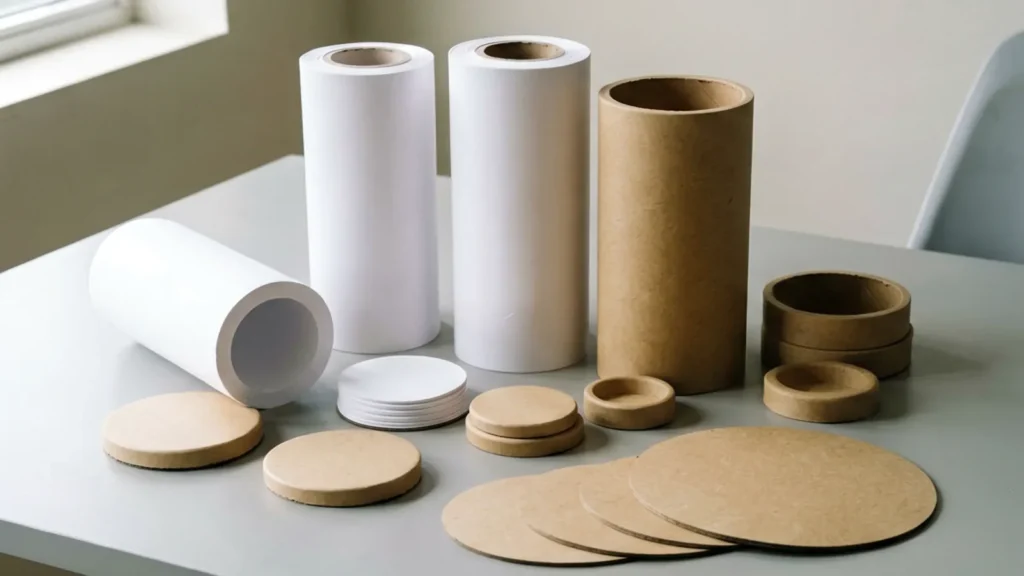
Tube specifications hide their cost in wall thickness and closure type. Comparing on those terms is more useful than comparing unit price.
Direct answer: For paper tube material comparison for custom, buyers should decide whether Paper Tube Material Comparison for Custom Orders fits the use case, specs, MOQ, sample approval path, and supplier quote process.
Define the Buyer Decision for Paper Tube Material Comparison
| Option | Best fit | Trade-off | Risk to avoid | Verification | Follow-up |
|---|---|---|---|---|---|
| Standard spiral-wound paper tube | Runs with stock diameters and standard wall thicknesses. | Limited diameter/wall options; may force design compromise. | Stock tube may not meet load or closure needs. | Confirm diameter, wall, and length against your product spec. | Request a spec sheet and sample before ordering. |
| Custom-diameter paper tube | Unique product dimensions or branding requirements. | Higher tooling cost and longer lead time. | Tooling investment may not pay back at low volume. | Verify mandrel availability and tooling amortization. | Ask for tooling quote and MOQ impact. |
| Paper tube with custom printing | Branded packaging for retail or gifting. | Print setup adds cost and lead time. | Color mismatch or print defects on curved surface. | Request printed samples and approve color proof. | Send artwork and request a proof before bulk. |
| Recycled-content paper tube | Sustainability-focused brand or corporate mandate. | May have slightly lower strength or color consistency. | Recycled content claim may not be verified. | Ask for recycled-content documentation or certificate. | Request material data sheet and sample test. |
Use this decision matrix as an approval sequence. For standard spiral-wound paper tube, a poor decision can mean stock tube may not meet load or closure needs. Ask the supplier to confirm diameter, wall, and length against your product spec.
For paper tube material, preserve the standard spiral-wound paper tube decision under one revision number: keep the supplier response, marked sample, approved specification, quotation, and approval owner together. If the evidence conflicts with the approved record, hold the quote, sample, or production release until the deviation is explained in writing. Once the buyer and designated technical authority have accepted the evidence, carry the signed decision criteria record into the purchase order, production handoff, shipment release, and later reorder review so every team works from the same baseline.
Material and specification fit
Paper tube material choice starts with your product's weight, diameter, and closure needs. Standard tubes work for common sizes, but custom diameters or wall thicknesses may require new tooling. Check the tube's crush strength and moisture resistance against your filling and shipping conditions. A sample test under real handling conditions beats a spec sheet alone.
Supplier reliability and quality checks
Supplier reliability shows in how they handle spec confirmation, sampling, and quality checks. Ask for a pre-production sample and agree on dimensional tolerances and print color before bulk. During production, request in-line or final inspection reports, especially for wall thickness and print registration. A supplier who documents these checks is more likely to deliver consistent tubes.
Confirm Product and Order Scope
- Can you provide a physical sample of the paper tube material for wall thickness and surface check? Confirms the material's actual feel, stiffness, and printability before bulk commitment. Supplier sends a pre-production sample within agreed timeline. Accepting a spec without a sample may lead to mismatched quality in bulk. Request a sample and compare against your product's weight and diameter.
- How do you verify the paper tube's crush strength for our product's stacking load? Confirms the tube can handle the weight during shipping and storage. Supplier describes a compression test method or provides a test report. Weak tubes may collapse, damaging your product and causing returns. Ask for a crush test result or conduct a simple field test on the sample.
- What is your process for approving the material before bulk production? Clarifies the approval gate so you control the final material choice. Supplier requires your sign-off on a pre-production sample before bulk run. Skipping approval can lock you into a material that fails your quality bar. Define the approval step in the purchase order and hold production until signed.
Decision criteria to confirm
Before you commit to a paper tube material, verify the supplier's capability with a physical sample. Check wall thickness, surface smoothness, and how the tube feels when you squeeze it. This confirms the material matches your product's weight and diameter needs. A supplier that sends samples quickly shows they understand the importance of this check.
RFQ details to send
When you request a quote, include your product's weight, diameter, and closure type. This helps the supplier recommend the right paper tube material and wall thickness. Also ask about their standard tolerances and whether they can meet your required crush strength. Clear RFQ inputs reduce the risk of mismatched specs and costly rework later.
Production handoff details
Before bulk production, confirm the supplier will hold the run until you approve the pre-production sample. This approval gate is your last chance to catch material issues. Document the approved sample and its specifications. This prevents the factory from substituting a cheaper material without your knowledge, protecting your product's quality and your brand's reputation.
Build the Verification Checklist
At this stage, your material comparison should yield a single, documented output: a vendor-neutral specification sheet that your team can use to verify quotes, samples, and production runs. Before you move to the next stage, you need a checklist that covers five areas: specs, cost or MOQ, production risk, factory execution, and quote request/sample handoff.
Use this ordered list as your starting point, and adapt it to your product’s end use (e.g., cosmetics, food, or industrial).
- Specs: Confirm inner/outer diameter, wall thickness, length, and tolerance. Also verify material grade (e.g., virgin vs. recycled board) and any coatings or liners.
- Cost or minimum order: Request a full cost breakdown per unit, including tooling, setup, and artwork charges. Clarify minimum order tiers and how price scales with volume.
- Production risk: Ask about dimensional stability, moisture resistance, and print registration. Identify potential failure points like seam strength or edge chipping.
- Factory execution: Verify the factory’s process controls—how they measure and record tolerances, and how they handle defects. Request a pre-production sample for sign-off.
- quote request/sample handoff: Ensure your quote request includes all specs and a clear sample request. Define the approval process for samples and the timeline for feedback.
To make the checklist actionable, turn it into a simple scoring table. Rate each vendor from 1 to 5 on each criterion, and weight the criteria based on your product’s needs. This turns subjective impressions into a comparable score.
| Criterion | What to Verify | Why It Matters |
|---|---|---|
| Specs | Dimensions, material grade, coatings | Ensures the tube fits your filling line and end-use requirements. |
| Cost/MOQ | Unit price, tooling, MOQ tiers | Reveals total cost of ownership and scalability. |
| Production risk | Dimensional tolerance, moisture resistance | Reduces the chance of field failures or rework. |
| Factory execution | Process controls, defect handling | Indicates reliability and consistency. |
| RFQ/sample handoff | RFQ completeness, sample approval process | Prevents miscommunication and delays. |
Once your checklist is populated, you can confidently move to the next stage: comparing quotes and production assumptions. For more guidance on custom packaging, see our packaging dieline and custom packaging specs.
Compare Quote and Production Assumptions
| Criteria | Baseline option | Confirmed option | Buyer meaning | Risk to avoid | Follow-up |
|---|---|---|---|---|---|
| Specification details | Wall thickness and inner diameter in millimeters | Paper weight (GSM) and ply count | Confirms the tube's structural fit for your product dimensions and weight. | Mismatched specs can cause crushing or loose fitting during use. | Request a spec sheet and compare against your product's exact measurements. |
| Cost driver | Material grade (virgin vs. recycled fiber) | Wall thickness and ply count | Identifies which specification most affects unit price and tooling. | Over-specifying material can inflate costs without adding functional value. | Ask for a cost breakdown per spec change and validate against your budget. |
| Quality control | In-process checks for diameter and wall uniformity | Final compression and crush testing on samples | Shows how the supplier ensures consistent tube strength and dimensions. | Inconsistent QC can lead to field failures and customer complaints. | Request QC checkpoints and test reports for your material grade. |
| Approval risk | Pre-production sample sign-off before bulk run | In-line inspection during production | Determines when you can catch and correct issues before full commitment. | Skipping sample approval can result in costly rework or rejected batches. | Confirm the supplier holds production until you approve the sample. |
Use this comparison table as an approval sequence. For specification details, a poor decision can mean mismatched specs can cause crushing or loose fitting during use. Request written proof and compare it with the approved sample or specification.
For custom packaging solutions, preserve the specification details decision under one revision number: keep the supplier response, marked sample, approved specification, quotation, and approval owner together. If the evidence conflicts with the approved record, hold the quote, sample, or production release until the deviation is explained in writing. Once the buyer and designated technical authority have accepted the evidence, carry the signed quote comparison record into the purchase order, production handoff, shipment release, and later reorder review so every team works from the same baseline.
Run the Review Before Approval
At this stage, your material comparison should yield a single, documented output: a vendor-neutral specification sheet that lists the chosen tube construction, dimensional tolerances, and finish requirements. Before you approve the PO or send the quote request, run this review sequence to catch mismatches that cause rework or delays.
Questions to send back to the supplier
- Confirm the exact wall thickness and inner/outer diameter tolerances for your tube—do they match your filling or capping equipment?
- Ask for a physical sample or a detailed spec sheet that verifies the paperboard grade and moisture content, especially if you need high crush strength.
- Clarify the printing and coating process: is the artwork applied inline or offline, and what is the maximum number of colors without affecting the tube’s structural integrity?
- Request a breakdown of the cost drivers—paper grade, wall layers, and finishing—so you can see where you can adjust without sacrificing performance.
- Ask about the supplier’s quality checkpoints during production: how do they measure diameter, wall thickness, and print registration?
When to revise, escalate, or reject
If the supplier’s answers reveal a mismatch in tolerances or material properties, revise your specification before approving. Escalate when the supplier cannot provide a physical sample or a clear process reference for quality control. Reject the proposal if the cost or minimum order is based on a different tube construction than what you specified, or if the supplier cannot commit to your required dimensional accuracy.
Use this simple review table to guide your decision:
| Checkpoint | Pass | Revise | Reject |
|---|---|---|---|
| Spec match | Tolerances and materials align with your spec | Minor deviations that can be corrected | Major deviation in wall thickness or diameter |
| Cost transparency | Clear cost drivers and no hidden fees | Vague cost breakdown | Unrealistic low quote with different spec |
| Production risk | Supplier shows quality checkpoints | No sample or process reference | No quality control plan |
| RFQ/sample handoff | Sample matches spec and is approved | Sample needs minor adjustments | Sample fails functional test |
After this review, you should have a clear go/no-go decision. If you pass, proceed to finalize the order. If you revise, send the updated spec back to the supplier. If you reject, restart the material comparison with a new supplier. For more on our quality approach, see paper packaging quality control.
Move from Review to RFQ or Sample
If your material comparison has produced a clear front-runner across the criteria that matter most to your product, you are ready to move from review to quote request or sample. The decision rule is simple: if one material meets your performance thresholds and the factory can execute it within your cost and minimum order constraints, proceed to request a quote or physical sample. If no material meets all thresholds, do not force a choice—return to the comparison and adjust your priorities.
Inputs to include in the next message
When you contact a factory for an quote request or sample, include the following inputs to avoid back-and-forth and ensure accurate pricing:
- Exact material specification (e.g., paperboard grade, thickness, coating) from your comparison.
- Dimensions and tolerance requirements for the tube (inner diameter, wall thickness, length).
- Quantity and target minimum order—confirm whether your order size aligns with the factory’s standard minimum order.
- Printing and finishing requirements (e.g., artwork files, ink type, lamination).
- Any performance tests or certifications you require (e.g., crush strength, moisture resistance).
Ownership and sign-off for the next gate
Before sending the quote request, assign ownership and sign-off responsibilities. The person who owns the material comparison should finalize the spec sheet. The purchasing lead should approve cost and minimum order alignment. The quality or engineering lead should sign off on production risk and sample evaluation criteria. This ensures that the quote request or sample request is complete and that the next gate—sample approval or pilot run—has clear accountability.
Source check: ISO 2859-1 sampling inspection standard; How to Choose the Right Paper Tube Packaging for Your Product?; 6 Step to How to Select the Perfect Product Packaging – Custom….
In conclusion
The sourcing choice for custom paper tubes comes down to a disciplined comparison of material properties, dimensional tolerances, and supplier process controls. Before you commit to a production run, verify that the tube’s wall thickness, inner diameter, and edge finish match the intended filling or labeling line, and document the approved specification sheet alongside a physical sample. Cost and minimum order are intertwined with material grade and tooling, so request a quote that itemizes board type, adhesive, and printing method, and confirm the lead time against your launch calendar. Quality risk concentrates in seam strength and moisture resistance, so ask the supplier for a test report or a pre-production sample that you can physically check. Shortlist a supplier who can show consistent process references and a clear approval gate for the sample, then move forward with a signed specification and a confirmed order.
To request a quote for paper tube material, use paper tubes products to confirm the final specification, quote assumptions, sample approval, QC evidence, approval risk, and supplier follow-up before bulk order.
Paper Tube Material Comparison FAQ
What should buyers confirm first?
It depends on the tube’s end use, so first confirm the core specification: inner/outer diameter, wall thickness, length, and required crush or edge-crush strength. Then compare how each material grade (kraft, recycled, or coated) affects cost and minimum order—confirm the exact minimum order and lead time in the quote request, as standard production is 15–30 working days after specifications, artwork, and sample requirements are confirmed. Verify the supplier’s material sourcing and any certifications, and request a physical sample to test dimensional tolerance and surface finish before committing.
Which proof should be retained for approval and reorders?
Retain the approved sample, the signed specification sheet, and the supplier’s material data sheet as the baseline for production and reorders. Document the wall thickness, diameter, and any coating or lamination details, plus the QC pass/fail criteria used during sample approval. For reorders, reference the same spec and sample, and confirm the supplier still uses the identical material grade—ask for a fresh sample if the material source changes.
Which warning signs should stop the order?
Stop the order if the supplier cannot provide a physical sample that matches your dimensional and strength specs, or if they refuse to document material composition and source. Also halt if the quoted minimum order or lead time deviates from the project-level 200 pcs or the standard 15–30 working days after specifications, artwork, and sample requirements are confirmed, without a clear reason, or if they lack verifiable quality control procedures. Confirm any certification claims with scanned documents before proceeding, and if the sample fails your crush or tolerance test, do not approve production.
quote request handoff: Send Specs for Review.
If this stage leads into that check, compare it against our paper Packaging Buyer Guide: Options, Specs, and Quote Checks.



Ask a Packaging Question