

Direct answer: Use a paper box when flat panels, inserts, stacking, or efficient flat shipment matter; a paper tube when a cylindrical form, radial protection, or distinctive opening is central; and a paper bag when lightweight carry, filling speed, or retail handoff leads. Compare total pack-out, product protection, freight volume, assembly, display, and reorder needs—not unit price alone.
- Start with product geometry, weight, fragility, and opening sequence.
- Compare protection, presentation, assembly, and freight volume.
- Request the same quote scope and approval evidence for every route.
- Validate the selected format with the actual product and shipping pack.
Method and limits: The comparison uses the packaging-function framework in ISO/IEC Guide 41:2018. The guide does not rank boxes, tubes, or bags and does not set project cost, strength, minimum order, or environmental claims. Supplier quotations, loaded samples, intended distribution, and market requirements must decide the final route. Reviewed 24 August 2026.
Paper boxes, tubes, and bags are easier to source when the buyer defines the use case, proof required, sample decision, and quote inputs before supplier outreach.
For these packaging formats, procurement should compare suppliers by the evidence behind the quote, not by a single unit price or a generic capability list.
The checks below help convert a broad packaging request into a cleaner sample approval and supplier response.
For brand owners and importers, keep the chosen format quote-ready: specs to send, proof to request, sample checks to approve, and reorder notes to retain.
How buyers should compare paper packaging box vs paper tube before choosing
Choose the packaging family from the packed product and the job the package must perform. The useful route is the one a supplier can convert, sample, inspect, pack, and repeat against the same buyer-approved reference.
| Format | Best starting fit | Confirm before routing | Risk if the route is wrong |
|---|---|---|---|
| Paper box | Rectangular products, retail display, inserts, flat converting, or presentation structures | Product fit, closure, insert retention, print area, assembly, and carton arrangement | Unused space, weak corners, slow assembly, or an insert that does not retain the product |
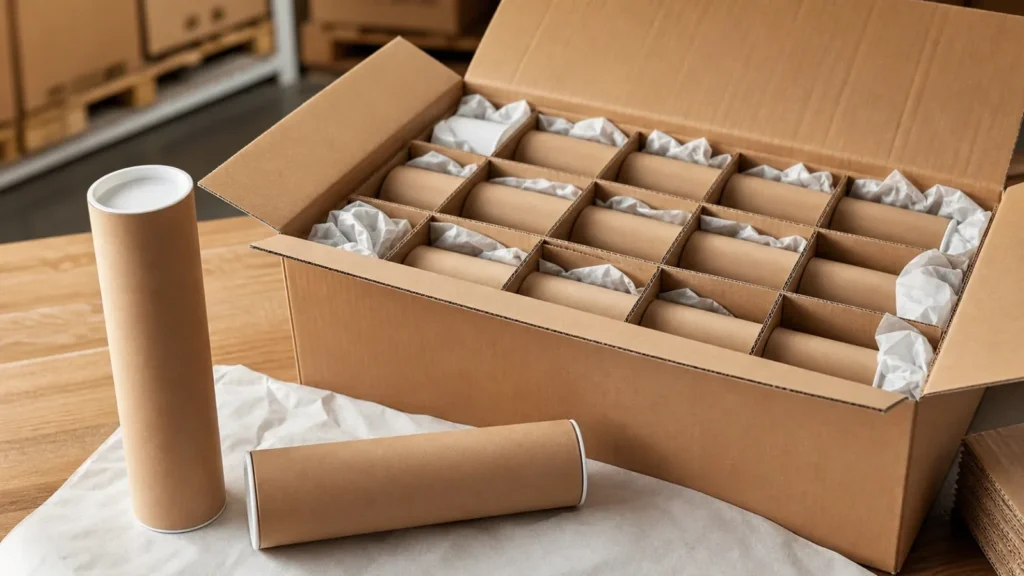
| Paper tube | Round or tall products, rigid cylindrical presentation, nested components, or cap-based openings | Loaded clearance, usable depth, cap engagement, removal action, labeling, and pack-out orientation | Loose contents, cap separation, trapped product, rolling in transit, or inefficient master cartons |
| Paper bag | Carry-out, lightweight retail orders, event distribution, or a secondary branded container | Loaded handle pull, bottom support, opening, print coverage, and packed shape | Handle pull-out, bottom failure, poor fit, excessive material, or use as primary protection |
Ask the supplier to return a route recommendation with loaded-sample evidence and to identify any process they do not control in-house. That response is more useful than choosing from an empty packaging mock-up or catalog image.
Which paper packaging box vs paper tube use case fits each packaging format
Use the route matrix above to lock the packaging family and product-fit inputs. This checkpoint compares the commercial assumptions that must stay consistent across supplier quotes.
Minimum-order basis by route
Ask the supplier to state which MOQ applies to each box, tube, or bag line and whether artwork, structure, finish, or packing creates a separate minimum. If one site-level figure is applied to every route, the selected quote can change after the format is approved.
When the production clock starts
Zhypacking’s standard production lead time is 15–30 working days after specifications, artwork, and sample requirements are confirmed. Put that start trigger on the quote and keep sample review and shipping outside the production range; otherwise the buyer cannot plan a reliable required-date buffer.
First-order versus repeat-order charges
Separate tooling, setup, sampling, assembly, packing, and unit pricing where they apply. Bundled charges hide the first-order basis and make repeat-order comparisons unreliable when box, tube, and bag converting processes differ.
- State the applicable MOQ beside every quoted route.
- Name the event that starts production lead time.
- Separate one-time charges from recurring unit pricing.
- Confirm quote validity, packing basis, freight term, and open assumptions before selection.
Record the approval risk when an unconfirmed minimum, clock start, or bundled charge could change the selected route.
After the commercial basis is aligned, review paper tubes products product route only for orders whose cylindrical fit and opening route remain suitable.
RFQ checkpoint
Choose the likely family, then send product dimensions, protection needs, artwork status, quantity, packing method, and destination for RFQ review.
How to translate paper packaging box vs paper tube use cases into specs
Turn the selected route into one specification sheet that the supplier can use for the dieline, loaded sample, production handoff, and inspection record.
| Route | RFQ fields to lock | Sample evidence | Failure to prevent |
|---|---|---|---|
| Paper box | Inside size, board route, closure, insert, print area, finish, assembly, and carton arrangement | Loaded fit, closure, insert retention, print registration, and packed movement | Loose product, crushed edges, slow assembly, or an insert that cannot be repeated |
| Paper tube | Inside diameter, usable depth, cap route, wall construction, product retention, labeling, and carton orientation | Loaded clearance, cap engagement, removal action, label position, and rolling control | Diameter mismatch, cap separation, trapped product, or inefficient pack-out |
| Paper bag | Finished size, gusset, paper route, handle, bottom support, print coverage, load, and carton packing | Loaded handle pull, bottom support, opening, print, and packed shape | Handle pull-out, bottom failure, poor fit, or use as primary protection when it is only a carry layer |
Name the approved sample revision, artwork version, material reference, accepted deviation, inspection method, and change owner in the handoff. The paper packaging quality control should verify the same specification rather than introduce a second set of requirements.
Read the table above by use case, not by surface appearance alone. Shortlist the construction whose handling risk can be checked on a representative sample, then carry that choice into the later specification record.
In conclusion
Selecting the right packaging family—paper box, paper tube, or paper bag—is the first and most critical decision in your RFQ route matrix. Each option carries distinct trade-offs in containment, protection, handling, and cost structure. The matrix simplifies this choice by mapping your product’s dimensions, fragility, and volume to the optimal format, then flagging the corresponding specification, MOQ, and lead-time parameters. For example, a cylindrical product with high crush sensitivity typically routes to a paper tube, while a flat, stackable item may favor a folding carton. Once the route is set, the buyer should validate the spec against factory capabilities, confirm the MOQ (Zhypacking’s project-level minimum is 200 pcs unless a product-specific exception is confirmed), and account for the standard 15–30 working day production lead time counted after specifications, artwork, and sample requirements are confirmed. Quality risk is minimized by aligning the chosen format with the supplier’s proven process—paper tube winding requires different machinery than box die-cutting or bag folding. Before committing to production, always request a physical sample to verify structural integrity, closure, and print registration. This matrix-driven approach ensures that your RFQ lands with the right supplier, reduces quoting delays, and sets a clear path from specification to sample approval.
To request a quote, visit custom paper packaging and confirm the final specification, quote assumptions, sample approval, QC evidence, approval risk, and supplier follow-up before bulk order.
Paper packaging box vs paper tube FAQ
When should a buyer choose a paper box instead of a paper tube or bag?
Choose a box when rectangular fit, inserts, stacking, or flat production is central; a tube when cylindrical rigidity and cap-based opening fit the product; and a bag when carrying or secondary retail containment is the main job. Review the custom packaging specification support after defining product dimensions and channel.
Which product details should be confirmed before choosing the packaging family?
Confirm product dimensions, filled weight, fragility, orientation, opening sequence, retail or shipping route, print area, and carton packing. These details prevent the family decision from being based only on appearance.
What should buyers send after selecting a paper packaging route?
Send internal dimensions, material preference, closure, insert or handle details, artwork status, quantity, destination, sample requirement, and packing plan. Ask the supplier to return open assumptions in writing before sampling.
How should buyers compare MOQ, lead time, and quote terms?
Compare the same specification, quantity tier, tooling, sample step, bulk start condition, packing basis, freight term, and quote validity. The quote should confirm route-specific terms rather than relying only on site-level starting figures.

Ask a Packaging Question