
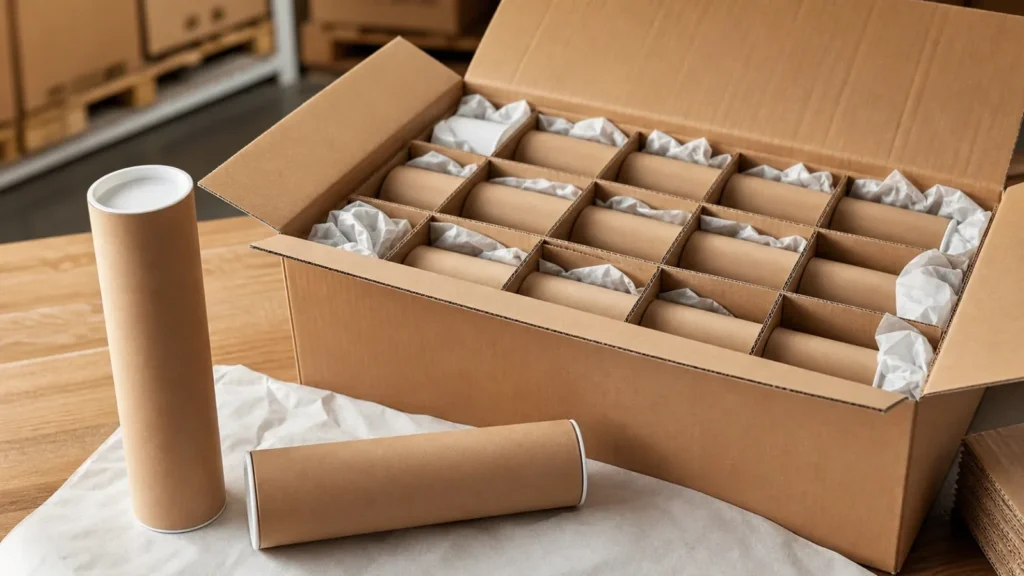
Paper tubes ship badly when nobody specifies the journey: caps work loose, walls crush at the ends, labels scuff against the carton, and the sample that looked perfect arrives tired.
This shipping checklist covers the specs, proofs, and RFQ checks that keep tubes intact from factory to customer.
- Bottom line: specify the route before specifying the decoration.
- Caps, ends, and crush strength are shipping specs, not styling notes.
- Approve on a tube that actually traveled the channel.
- Carry the evidence into every reorder.
Direct answer: Release the order only after the intended use, approved construction, test record, commercial terms, and sign-off responsibility all match. If one item remains unresolved, return it to the responsible buyer or supplier before bulk production.
Specify the Shipping Fields First
These fields decide whether the tube arrives as it left. Put them on one revision of the spec sheet before decoration decisions close.
| Field to specify | What it controls | Risk if vague | Verification evidence to return |
|---|---|---|---|
| Wall crush strength | Holds end and side loads through stacking and impacts | Crushed rims and dented bodies in transit | Stack and drop evidence matched to the channel |
| Cap and end security | Caps stay seated through vibration and handling | Lost caps and exposed contents on arrival | Shake and inversion check on the packed tube |
| Surface protection | Wrap or coating that survives carton contact | Scuffed print and labels at unpacking | Rub check after a packed transit simulation |
| Moisture behavior | Board response to humidity shifts in transit | Warped tubes and loose caps after climate changes | Humidity-exposed sample where the route demands it |
| Packing plan | How tubes are bundled, celled, or cartoned | Tubes working against each other in the carton | Carton pack pattern stated with the quote |
A quote silent on these fields is quoting a tube for the showroom. The route always gets a vote — better to give it one at spec time.
Match the Format to the Journey
- Direct courier shipping the tube is the package: wall strength and cap security carry everything.
- Tube inside a carton presentation tubes riding in mailers: coordinate both packages against scuff and movement.
- Document and print tubes end closures matter more than decoration; caps or crimped ends per contents.
- Retail-ready tubes shelf exposure adds light and handling: finishes must survive more than transit.
Run the choice as a head-to-head comparison: same contents, two pack strategies, one packed test each. The use case that fits both the product and the journey is the one to spec — not the one that photographs best.
Use paper bags format and sample approval for related checks.
RFQ checkpoint
Check sizes, structures, materials, finishes, and quote details before sampling this order.

Translate the Journey Into Specs
- Channel severity courier sorting, handoffs, and delivery attempts set the protection bar.
- Contents behavior weight, fragility, and moisture sensitivity drive wall and cap choices.
- Climate span routes crossing humidity zones need board that tolerates the swing.
- Arrival condition define what “undamaged” means for your product: cosmetic, functional, or both.
Write each translation beside the spec it produces. Diameter, wall, cap style, liner, and finish quoted against a named journey compare honestly; quoted against nothing, they compare as guesses.
Use packaging dieline and custom packaging specs to align the related specifications and RFQ inputs.
Freeze the Approval Baseline Before Bulk
- Ship a real one send a packed tube through the actual channel before approval, not a desk test.
- Record the result photos and notes from arrival, attached to the sample revision.
- Sign the scope approval names what the evidence proves: crush, caps, surface, or all three.
- Gate production no bulk before the baseline exists — the record is cheap now, expensive later.
The baseline turns the shipping test into a contract. When arrival conditions are disputed, the signed record ends the argument fast. Keep the measured parameters — crush result, cap pull force, and surface state — beside the record, so the baseline is a specification, not a memory.
Use e-commerce packaging for related checks.
Carry the Evidence Into Reorders
- Same journey, same spec reorders ship on the baseline unless the route or product changed.
- Substitution watch board or cap changes need re-approval and a fresh packed test.
- Lot trace arrival complaints traced to the lot record before supplier discussions.
- Trend review damage patterns reviewed each quarter, not after a bad month.
Reorder control is where shipping programs earn their cost: the twentieth shipment should arrive exactly like the approved sample did.
Use paper packaging quality control for related checks.
Conclusion: Approve on the Tube That Traveled
Final approval rests on four records agreeing: the sample, the spec sheet, the transit evidence, and the QC plan — all tied to the signed revision. Compare every dimension, cap fit, and surface standard against that baseline, and keep sampling while any of them disagree. Buyers who confirm the quote terms against that same baseline close the loop: scope, evidence, and price all asking the supplier the same question.
Bring the locked spec to the paper tubes range when the program is ready for volume.
Use the checklist as your planning frame and verify against your own route and contents; final approval should rest on the samples and records you collect for your program.
Tube Shipping FAQ
What should buyers confirm before ordering?
Diameter, height, wall construction, cap style, liner needs, surface protection, and the shipping channel — each written into one revision-controlled spec sheet.
How do we stop caps coming loose?
Specify fit tolerance and test packed tubes under vibration and inversion. Cap security is a tolerance decision — name the acceptable pull force instead of hoping for a snug fit.
Do tubes need moisture protection?
When the route crosses humidity zones or sits in unconditioned transit. Ask how the board behaves after exposure, and whether the caps stay fitted when it does.
When should the packed test be re-run?
After product changes, cap or board substitutions, route changes, or a new carrier — and once at first bulk, because production tubes can drift from samples.
RFQ handoff: For paper tube packaging shipping, share product size, material, artwork, quantity, sample need, packing method, and deadline so the RFQ can be reviewed before sample approval. Send Specs for Review.


Ask a Packaging Question