
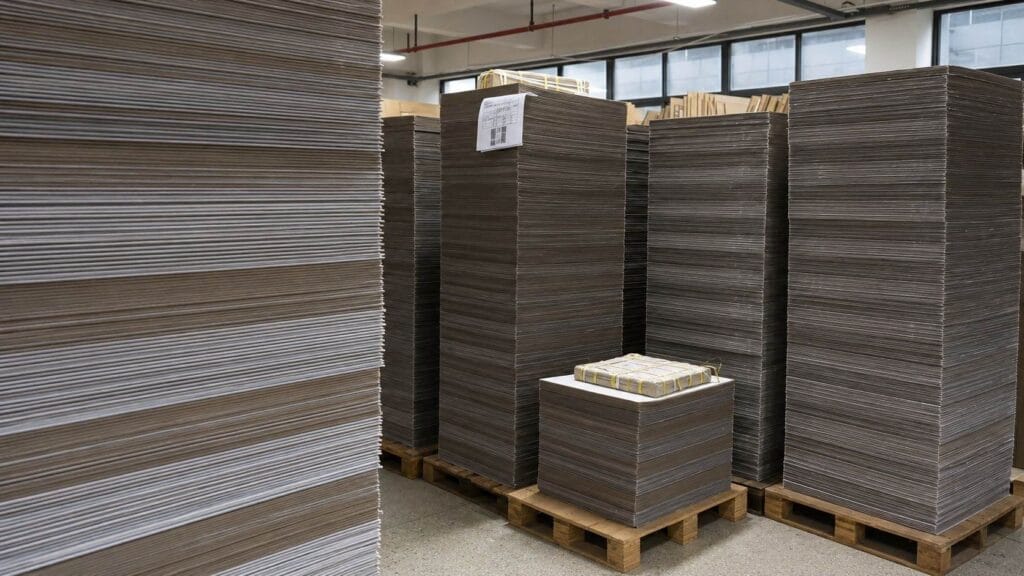
A paper-bag supplier may quote one headline MOQ while applying separate minimums to each size, paper, handle, print version, or finish. Without that breakdown, a low minimum can turn into excess stock or setup surcharges.
This checklist maps the SKU plan to tooling, print setup, material use, packing, and reorder demand so buyers can compare the total order—not just the lowest unit price.
Direct answer: Ask for MOQ and price by size, paper, handle, artwork version, print process, and finish. Separate one-time tooling and setup from unit cost, compare split-SKU and consolidated scenarios, then choose the quantity that matches realistic demand, storage, and reorder timing. Do not treat a supplier’s order-level minimum as a per-SKU guarantee.
- Send one specification matrix with quantity per SKU.
- Request per-SKU MOQ, shared setup, and item-specific charges separately.
- Compare total landed inventory exposure, not only unit price.
- Confirm sample, production, inspection, and dispatch timing in writing.
Method and limits: The checklist separates technical variables from commercial assumptions and delivery scope. ISO 536:2019 supports consistent description of paper and board grammage, while the ICC Incoterms rules clarify delivery responsibilities when a trade term is used. Neither sets a paper-bag MOQ, price, lead time, or viable SKU split; those values require a current supplier quotation. Reviewed 24 August 2026.
Define the Buyer Decision for Paper Bag MOQ Planning for Custom Orders
Compare the decision criteria for paper bag minimum order against one RFQ revision. Each row should identify the requirement, approval evidence, and buyer action before production.
| Requirement | Factory control | Evidence to verify | Order risk | RFQ follow-up |
|---|---|---|---|---|
| Sample approval | Lock written sample approval before bulk production starts. | Compare the sample with the tech pack and approved measurements. | Production can drift when no approved reference sample is recorded. | Attach the signed sample record to the purchase order. |
| MOQ and order quantity | Confirm MOQ by model, color, size run, and customization level. | Request separate quantity rules for stock and custom production. | A blended MOQ can hide color or size minimums and surcharges. | State quantity per model, color, and size run in the RFQ. |
| Lead time after approval | Separate sample, production, inspection, and dispatch timing. | Confirm the schedule against approval dates and production milestones. | One headline lead time can hide approval and inspection delays. | Request milestone dates and the event that starts each timing window. |
For paper bag minimum order, use the decision criteria as the decision scope. Read the rows as one approval sequence. Start with sample approval; use the risk and buyer-action columns to decide whether its evidence is sufficient. Verify it with the inspection method and approval evidence recorded in the table.
For this paper bag minimum order sourcing record, keep the supplier response, marked sample, and approval owner under the same revision number. If any proof conflicts with the approved record, hold the quote, sample, or production release until the supplier explains the deviation in writing. Before closing the checkpoint, reconcile the latest drawing, sample, quotation, and approval comments, identify which record controls if they disagree, and document the resolution. Carry the signed decision criteria table into the purchase order and production handoff so the same checks support quote comparison, sample approval, shipment release, and later reorders.
Material and specification cost drivers
Paper bag cost is driven by grammage, coating type, handle material, and print coverage. A 120 gsm kraft bag with twisted paper handles costs less per unit than a 200 gsm bag with cotton rope handles and full-bleed CMYK print. Buyers should specify each material layer and finish in the RFQ to avoid cost surprises during sample approval.
Customization, setup, and MOQ impact
Each custom element—die-cut shape, foil stamping, window patch, or custom size—adds setup time and tooling cost that is amortized across the order quantity. Custom paper bags use the project-level MOQ of 200 pcs unless a product-specific exception is confirmed, so ask for plate and jig costs as separate setup lines.
Questions to confirm before ordering:
For paper bag minimum order, treat the listed items as RFQ inputs. Match each buyer input to written supplier confirmation, approval evidence, and the risk that would hold the quote.
- Confirmed paper bag dimensions, gusset, and handle type: Dimensions directly affect material cost, carton packing, and final product structure. Mismatches lead to unusable bags and reorder delays. A 25x15x8 cm bag with flat handles vs. twisted paper handles Bags that do not fit packaging or handle specifications cause rework, scrap, and missed launch dates. Send dimension sketch with preferred handle style to supplier for quote request confirmation.
- Print quality standard: color tolerance, registration, and finish: Print consistency defines brand appearance. Off-register or mismatched colors damage brand perception and may require reprint. Pantone 186C red with a buyer-approved color tolerance, matte lamination, versus gloss UV Approved print without documented tolerance leads to color disputes and delayed shipment during approval. Request printed sample under standard lighting and document acceptable color range in the quote.
- Approval risk: artwork sign-off before sample approval: Signing off artwork before seeing a physical sample commits to production specs that may not print correctly on the bag substrate. A low-resolution artwork approved digitally but appears blurry on kraft paper after printing Production proceeds with flawed print, resulting in rejected goods and lost time for reorder. Require a printed sample on the actual bag material for final approval before bulk production.
- minimum order and order quantity per design variant: Each handle style, size, or print variant may have its own minimum order. Combining variants under one minimum order affects cost and inventory. Two bag sizes under one project minimum order of 200 pcs each, versus 200 pcs total across all variants Underestimating variant minimum order results in higher per-unit cost or inability to order a needed design. Confirm with supplier the minimum order per unique specification and document it in the quote approval.
Paper bag GSM, size, and handle type are the primary cost drivers in a custom order. Heavier GSM increases material cost and may raise the minimum order because mills require minimum paper roll purchases. A buyer should confirm these specs early to avoid budget surprises and ensure the bag can hold the intended product weight without failure.
Every handle style, size variant, or print color requires separate plate making and die-cutting setup. These fixed costs spread across the order quantity. A low minimum order per variant raises per-unit cost. Confirm minimum order per unique spec to align budget with actual production needs.
Quotes often exclude artwork revision costs, sample shipping, or carton packing variations. Without a clear packing spec, a buyer may receive bags that do not fit their warehouse pallet rack or shipping cartons. Always request a full cost breakdown including packing, palletizing, and any revision fees before approving the quote.
Confirm Product and Order Scope
| Cost driver | What changes it | Quote signal | Risk to avoid | Buyer action |
|---|---|---|---|---|
| Paper grammage (GSM) and coating type | Higher GSM or a PE coating adds material weight and lamination cost per bag. | Supplier quotes a per-unit price break at 300 GSM vs. 200 GSM for the same size. | Under-specifying GSM may cause bag failure during filling; over-specifying inflates MOQ cost. | Verify the GSM and coating against your product weight and moisture needs before RFQ. |
| Handle material and attachment method | Twisted paper handles cost less than cotton rope or die-cut handles; glued attachment is faster than tied. | Quote shows a separate line item for handle material and labor per 100 bags. | Choosing a handle that requires manual tying can extend production time and raise MOQ rejection. | Confirm handle type and attachment method with the factory to match your budget and lead time. |
| Custom size and die-cut shape | Non-standard dimensions require a new die, which adds a one-time tooling fee and extends setup time. | Quote includes a die-cut tooling charge and a note that MOQ applies per size variant. | Ordering multiple custom sizes under one MOQ may split the quantity, increasing per-unit cost. | Standardize bag dimensions across your product line to avoid separate die charges. |
Use this cost breakdown table as an approval sequence. For paper grammage (gsm) and coating type, a poor decision can mean under-specifying gsm may cause bag failure during filling; over-specifying inflates minimum order cost. Request written proof and compare it with the approved sample or specification, then verify the gsm and coating against your product weight and moisture needs before quote request.
For the paper grammage (gsm) and coating type checkpoint, keep the supplier response, marked sample, approved specification, quotation, and approval owner under the same revision number. If the evidence conflicts with the approved record, hold the quote, sample, or production release until the deviation is explained in writing. Carry the signed decision record into the purchase order, production handoff, shipment release, and later reorder review so every team works from the same baseline.
Decision criteria to confirm
Before approving the cost breakdown, verify that every custom paper bags element—grammage, coating, handle, print, and size—is listed with its per-unit impact. A missing line item often means the supplier will add it later as a change order. Compare the quote signal for each driver against your original quote request to catch scope creep early.
RFQ details to send
Use the cost breakdown table as a checklist when you prepare your quote request. For each cost driver, confirm that your spec is complete and that the supplier has quoted the exact combination. For example, if you need a PE-coated bag with a twisted paper handle, ensure both are listed. This prevents mismatched quotes that waste time.
Production handoff details
Once the quote is approved, lock the cost breakdown into the production order. Each driver—GSM, handle type, print colors, and size—must match the approved sample. A deviation in any one can trigger a re-quote or delay. Share the breakdown with your QC team so they know what to check during the first-piece inspection.
quote request checkpoint
Build the Verification Checklist
- Supplier cannot produce custom paper bags at minimum order 200 pcs consistently. Small runs strain production lines, risking delayed orders and higher per-unit cost. Request a capability statement and recent order records for similar custom paper bags. Order history, machine capacity sheet, and minimum order policy per product line. Shortlist only suppliers who confirm they can run 200 pcs custom paper bags.
- No pre-production sample approved before bulk run. Unapproved samples lead to material, size, or print defects that are expensive to fix. Insist on a signed sample approval form before releasing production. Signed sample approval record with date, spec checklist, and photo. Lock sample approval as a hard gate in the production order.
- Artwork or spec changes are not documented in writing. Verbal changes create disputes and rework costs that are not recoverable. Require all revisions to be submitted via email or quote request amendment with version number. Email trail with clearly marked revision dates and sign-off from both parties. Compare the final artwork against the approval record before each print run.
- Production sample does not match the approved material specification. Different GSM or coating affects bag strength and customer perception. Compare the sample against the specification sheet using a calibrated scale and caliper. Mill certificate for paper lot, GSM test report, and coating type confirmation. Reject the sample and request a replacement that matches the exact spec.
- Order quantity is below the project-level minimum order of 200 pcs without exception. Suppliers may charge a setup fee or refuse the order, causing sourcing delays. Verify the minimum order per product code; some items like custom paper boxes have a 200 pcs minimum. Supplier's minimum order sheet or written confirmation for the specific product and quantity. Consolidate orders or adjust quantity to meet the minimum order; do not place a sub-minimum order order.
Compare Quote and Production Assumptions
The main failure mode for paper bag minimum order is approval before the supplier has resolved the listed evidence gaps.
- How does the quote break down cost drivers like handle style, size, and print colors? Cost drivers vary by custom element; a quote that lumps all costs hides overruns. Quote shows per-item cost for each spec variant and includes plate making and shipping. Ignoring cost drivers may cause budget overrun after sample approval. Compare cost breakdown across suppliers and verify assumptions with sample order.
- What approval gates are needed before production to avoid quote drift? Without approval gates, changes after sample sign-off increase cost and delay delivery. Supplier provides a written approval checklist covering minimum order, specs, and artwork. Missing approval gates results in rework fees and missed launch dates. Document each approval gate (spec, sample, cost) and lock before production starts.
- Can the supplier provide custom packaging solutions for paper bags with varied minimum order requirements? One-size-fits-all minimum order policies often fail for custom paper bag orders with multiple SKUs. Supplier offers flexible minimum order per product variant and provides sample at negotiated cost. Inflexible minimum order may force you to commit to one design without testing market response. Confirm minimum order per SKU and request a sample order option before bulk production.
Run the Review Before Approval
Before you sign off on a Zhypacking custom order, confirm that every requirement from your quote request is addressed in the supplier’s quote and sample. This checkpoint ensures that cost, specs, and production risk are aligned before committing to a larger run.
Questions to send back to the supplier
- Does the quoted unit price include all customizations (size, print, finish) as specified in the quote request?
- What is the confirmed minimum order quantity for this exact specification, and how does it affect the per-unit cost?
- Can the supplier provide a sample that matches the approved artwork and material grade before production?
- What is the lead time from sample approval to shipment, and what happens if the sample fails?
- Are there any hidden costs for setup, tooling, or color matching that were not in the initial quote?
When to revise, escalate, or reject
If the supplier cannot confirm the minimum order for your custom spec or the sample deviates from your artwork, revise the order scope or escalate to a senior buyer. Reject the quote if the per-unit cost exceeds your budget by more than your agreed margin without a clear justification. Use this table to compare key requirements against the supplier’s response:
| Requirement | RFQ Spec | Supplier Response | Action |
|---|---|---|---|
| Material grade | Specified in RFQ | Confirmed | Proceed |
| Print color match | Pantone code | Sample pending | Request sample |
| MOQ for custom size | the quoted quantity | Confirmed | Proceed |
| Unit price at MOQ | Budgeted | Within the agreed margin | Negotiate |
| Lead time | supplier-confirmed timing | supplier-confirmed timing | Escalate |
After resolving any discrepancies, request a final sample and written confirmation of the order scope. Only then approve the production run.
Move from Review to RFQ or Sample
The ambiguity in paper bag minimum order planning is whether the supplier’s quoted cost and execution align with your custom order requirements. The control that prevents this is a formal handoff from review to an quote request or sample request, ensuring every specification, cost element, and production risk is communicated before commitment.
Inputs to include in the next message
When moving to the next gate, your message must include the following verified inputs. Each input reduces the risk of misalignment at the factory.
- Complete specification sheet with dimensions, material, and printing details.
- Approved cost breakdown covering material, labor, and tooling charges.
- Production risk checklist addressing common issues like ink bleeding or seam weakness.
- Factory execution timeline with key milestones for sample approval.
- quote request or sample handoff protocol specifying who reviews and approves each step.
Ownership and sign-off for the next gate
Clear ownership prevents delays. The gatekeeper for the buyer follow-up—usually the procurement lead or quality manager—must sign off on the completed inputs. Use the table below to assign responsibility.
| Input | Owner | Sign-off Required |
|---|---|---|
| Specification sheet | Design team | Yes |
| Cost breakdown | Finance | Yes |
| Production risk checklist | Quality assurance | Yes |
| Factory execution timeline | Procurement | Yes |
After sign-off, the quote request or sample request can proceed. This structured approach ensures that no critical detail is missed and that the supplier has clear expectations.
Source check: ISO/TC 122 packaging standards; What is the typical minimum order for custom printed craft paper bags fro…; The 5-Step Paper Bag Supplier Verification Checklist.
In conclusion
The sourcing choice for custom paper bags ultimately comes down to verifying that every specification, cost driver, and minimum order tier is documented before the order moves forward. By comparing your exact bag dimensions, material, print colors, and handle type against the supplier’s quoted minimum order and lead time, you can shortlist only those factories that can deliver without hidden rework. Approve the final sample only after the artwork proof, material swatch, and production timeline are confirmed in writing, then request a quote that locks in the agreed quantity and price.
To request a quote for paper bag minimum order, use packaging dieline and custom packaging specs to confirm the final specification, quote assumptions, sample approval, QC evidence, approval risk, and supplier follow-up before bulk order.
Paper Bag MOQ Planning for Custom Orders FAQ
What should buyers confirm first?
Buyers should first confirm that their custom paper bag specification—including dimensions, paper weight, handle type, and printing method—falls within the supplier’s standard production capability, as this directly affects the minimum order. For a standard custom paper bag, the project-level minimum order is 200 pcs, but you must verify this number in your quote request if your spec requires a non-standard material or a complex finishing process, which could raise the minimum. Compare the quoted cost per unit at the supplier’s minimum order against your budget, and ask for the lead time, which is typically 15–30 working days after specifications, artwork, and sample requirements are confirmed. Document every specification detail in writing before the supplier begins tooling or material procurement to avoid mid-order changes that could increase the minimum order or delay production. Ask how QC will check the sample, color, finish, packing, and bulk order.
Which proof should be retained for approval and reorders?
Retain the signed-off artwork proof, the final pre-production sample (or its photo and measurement report), and the written confirmation of the agreed minimum order, unit cost, and lead time. For reorders, keep the original sample as a physical reference and the approved specification sheet, so the supplier can replicate the exact paper type, color, and dimensions without re-qualification. Request that the supplier provide a sample approval form that includes the minimum order, cost break, and production timeline, and file this with your purchase order to streamline future reorders and avoid discrepancies in quality or quantity.
Which warning signs should stop the order?
Stop the order if the supplier cannot confirm the minimum order for your exact custom specification in writing, or if the quoted lead time exceeds the standard 15–30 working days (counted after specifications, artwork, and sample requirements are confirmed) without a clear reason. A warning sign is when the supplier asks you to approve a sample that deviates from your spec—such as a different paper weight or handle attachment—without offering a revised cost and minimum order. Also halt the process if the supplier refuses to provide a pre-production sample for QC verification before full production, as this increases the risk of receiving bags that do not match your approved design. Document any discrepancies in the sample approval and request a corrected sample before proceeding.
quote request handoff: Send Specs for Review.
For the next step on this route, see our gusseted Paper Bag Quote Inputs: Cost Drivers and RFQ Checklist. For the next step on this route, see our packaging Accessories MOQ Planning for Custom Orders Cost Checklist.

Ask a Packaging Question