

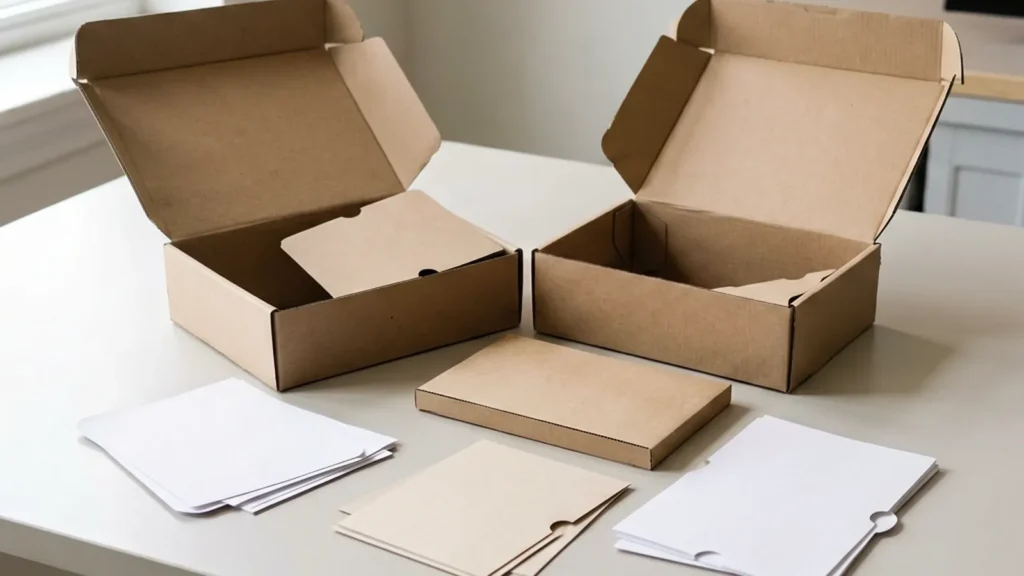
An insert is the part of a mailer box customers touch first — and the part that fails first: products rattle, lids bulge, or the unboxing sequence falls apart on the second open.
This guide walks the fit, protection, and unboxing checks that keep a mailer program solid from sample to reorder.
- Bottom line: fit is engineered from product dimensions, not box catalogs.
- Choose the insert for protection and unboxing together.
- Approve on a packed, opened, and re-closed sample.
- Lock the baseline so reorders feel the same.
Direct answer: Release the order only after the intended use, approved construction, test record, commercial terms, and sign-off responsibility all match. If one item remains unresolved, return it to the responsible buyer or supplier before bulk production.
Specify the Fit Before Choosing the Look
These fields decide whether the box protects and reveals the product as intended. Put them into one revision of the spec sheet before any finish discussion starts.
| Field to specify | What it controls | Risk if vague | Verification evidence to return |
|---|---|---|---|
| Internal cavity dimensions | Holds the product set without rattle or forced closure | Movement damage or crushed lids | Measured fit across several packed units |
| Insert style | Foam, card divider, or folded paperboard matched to fragility | Over- or under-protection for the real route | Protection rationale stated per product family |
| Board grade | Mailer rigidity for the packed weight and stack load | Bulging lids and corner crush in transit | Grade stated with the packed-weight basis |
| Closure and reopen | Self-lock behavior over repeated opens | Loses grip after the first open | Open-close cycle check on the sample |
| Unboxing sequence | The order a customer meets the product | A confusing reveal that weakens the brand moment | Sequence reviewed on the packed sample |
If two of these fields stay vague at quote stage, the sample will answer them by surprise — at your cost.
Request factory proof and name the responsible process owner before the buyer signs the approval record.
Pick the Insert for Protection and Unboxing Together
- Die-cut foam best for fragile items needing zero movement; heavier cost and longer tooling.
- Card dividers good for multi-piece sets where separation matters more than cushion.
- Folded paperboard platforms a balance option that keeps the pack recyclable and printable.
- Hybrid nests card platform with targeted cushioning where the product needs it.
Treat the choice as a head-to-head trade-off: run the same packed test on two insert options and compare movement, reveal, and cost on the same order. The best insert is the one the product and the unboxing goal choose together — a fragile device suits foam even in a kraft aesthetic, while a textile set may need nothing more than tissue and a divider.
Name the inspection record and pass/fail owner, and record the approval risk if the evidence does not match the approved requirement before the buyer signs the approval record.
Use packaging dieline and custom packaging specs for related specification options.
RFQ checkpoint
Check the product range for sizes, structures, materials, finishes, and RFQ details before sampling custom mailer boxes with inserts.

Control the Approval Risks
- Dimension drift internal size changes after artwork lock; hold a revision rule for both.
- Insert substitution foam density or card grade swapped quietly; require re-approval for any change.
- Over-spec cost paying for protection the route does not need; quote by channel severity.
- Under-spec damage claims that cost more than the insert ever saved.
Each risk maps to one control: written spec, change rule, channel-based quoting, and packed evidence. Put all four into the approval record and the program stays defensible at reorder.
Confirm the sample timing and bulk production schedule affected by this checkpoint before the buyer signs the approval record.
Use custom printed tissue paper products for related options.
Match Structure to Product, Route, and Handling
- Product weight, fragility, and shape define cavity depth and board rigidity.
- Route courier handoffs and sorter impacts set the protection bar.
- Handling how often the box is opened and re-closed sets the closure spec.
- Brand moment the reveal sequence decides where print and finish earn their cost.
A specification sheet that links product dimensions, insert layout, board grade, and route severity is the output to hold before sampling. Without it, each supplier designs a different box around the same artwork.
Name the inspection record and pass/fail owner, state what the buyer must check, measure, or request as proof, and record whether the next step is quote revision, sample approval, shortlist, or production release.
Use custom packaging solutions for related options.
Move the Checks Into the RFQ
- Attach the spec sheet with cavity dimensions, insert style, board grade, and closure spec.
- Itemize box, insert, tooling, and packing costs per design.
- Name the evidence packed fit check, open-close cycle, and route simulation required before approval.
- State the terms minimums per design, timing triggers, and the substitution rule.
Route the request through the mailer boxes range so structure, insert, and print stay quoted as one program. MOQ and lead time arrive meaningfully only after the fit is specified — before that, they describe different boxes. A factory quotes the program accurately when fit and evidence arrive specified, because production planning can start from one complete picture.
Conclusion: Approve on the Packed Sample
Final approval means comparing the supplier’s packed sample against the signed specification: fit, insert, board, and closure all matching, with cost drivers and minimums itemized in the same record. Shortlist the suppliers whose samples and documents agree; keep sampling where they do not.
Use the checklist as your approval frame, and let your own packed samples confirm the risk points before volume.
Mailer Insert Fit FAQ
What should buyers confirm before ordering?
Internal dimensions, insert style and material, board grade, closure behavior, and the unboxing sequence — each tied to the product and the shipping channel.
Which insert suits fragile products?
Die-cut foam or a hybrid nest, verified with a packed drop or shake check. Ask for the density spec, because “foam” alone covers a wide range of protection.
How do we keep the unboxing consistent across reorders?
Lock the insert tooling and cavity dimensions in the baseline file, and inspect incoming lots against them. Sequence drift usually starts with an unrecorded tooling tweak.
When does an insert stop being worth it?
When the route is gentle, the product is robust, and the brand moment does not depend on a staged reveal — tissue and a snug fit may carry the experience for less cost.
RFQ handoff: For custom mailer boxes with inserts, share product size, material, artwork, quantity, sample need, packing method, and deadline so the RFQ can be reviewed before sample approval. Send Specs for Review.
For the next step on this route, see our mailer Box vs Shipping Box vs Folding Carton: Buyer Fit Guide.

Ask a Packaging Question