
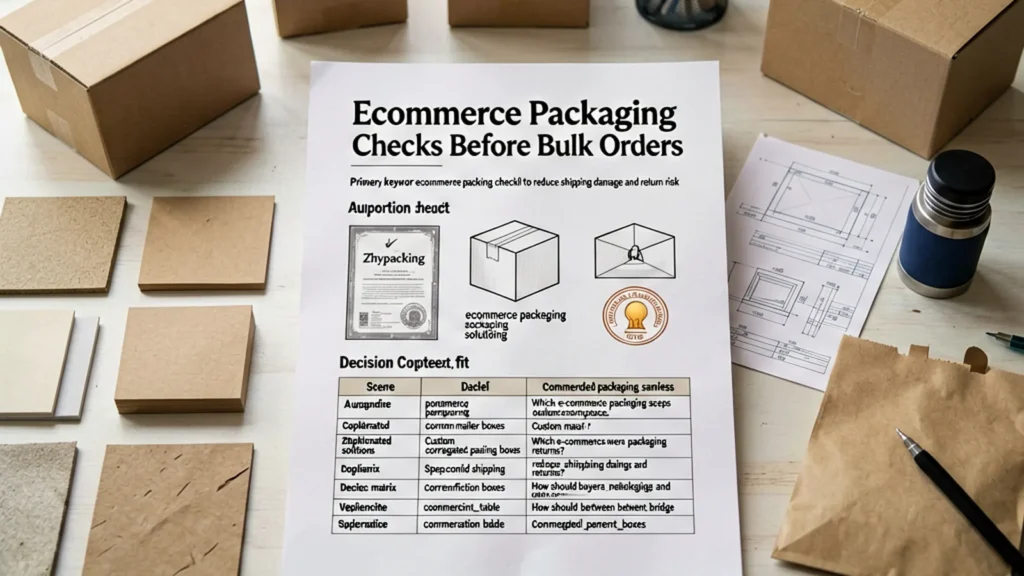
Jewelry packaging fails on fit long before it fails on looks: a ring slot that rattles, a necklace cavity that tangles chains, a drawer that sticks after one season of humidity.
This checklist turns fit into RFQ fields: what to prepare before quoting, what to specify, what to separate from supplier assumptions, and how to reconcile the sample with the offer.
- Bottom line: fit starts from the product’s measured dimensions, not the catalog picture.
- Insert cavity, closure feel, and protection are spec fields, not hopes.
- Mark every assumption in the RFQ so quotes stay comparable.
- Reconcile sample evidence against the offer line by line before award.
Direct answer: Measure the actual jewelry, not the line average, because the largest and heaviest piece defines the cavity. State slot width and foam cutout tolerance per piece, and add anti-tarnish or cushioning needs per metal and stone. Reconcile fit photos, closure feel, and the itemized offer line by line before award.
How this guide was prepared: The checklist maps actual jewelry dimensions, weight, surface sensitivity, insert geometry, closure and handling to RFQ and sample evidence. ISO/IEC Guide 41:2018 provides general recommendations for consumer packaging functions including containment, protection, handling and presentation. It does not prescribe jewelry insert tolerances, cushioning or anti-tarnish performance; those requirements must be agreed for the actual piece and verified on the sample. Reviewed 24 August 2026.
Prepare the Product Facts Before Asking for Quotes
Suppliers quote fit accurately when the product dimensions, weights, and presentation level arrive measured. Packaging brief checklists such as this jewelry and beauty packaging brief checklist put the same facts at the top of the request.
| Application | Fit condition | Risk to avoid | Specification or proof |
|---|---|---|---|
| Necklace or bracelet in a rigid box | Interior depth matching product height plus insert thickness | Product shift in transit causing tangles or surface marks | Insert cavity dimensions and a fit photo with the real piece |
| Ring or stud in a drawer box | Slot width and foam cutout sized to hold without forcing | Loose movement or scratched metal from tight pulls | Slot tolerance stated per jewelry type |
| Earring cards and small sets | Card retention and closure strength for repeated opening | Cards sliding out during shelf handling | Closure cycle check on the sample |
| Mixed collections | Modular insert plan across SKUs | One insert forced to serve incompatible shapes | Insert map naming each SKU and cavity |
Send the dimensions of the actual jewelry, not the average of the line — the largest and heaviest piece defines the cavity.
Specs Premium Buyers Should Confirm
- Cavity and insert depth, foam cutout shape, and retention per jewelry type.
- Material board grade, wrap paper, and finish — with a data sheet where the brand story needs it; eco positioning guides like eco-friendly jewelry packaging show which claims need backing.
- Closure behavior drawer glide, magnet strength, or hinge feel — approved by hand, on the sample.
- Protection anti-tarnish or cushioning needs named per metal and stone.
- Presentation level the unboxing moment the brand pays for, described concretely.
Fine jewelry programs document these fields in detail; fine-jewelry packaging guides such as the ultimate guide to fine jewelry packaging reflect the same expectation. Every field you confirm removes one assumption from the quote.
Use packaging dieline and custom packaging specs to align the related specifications and RFQ inputs.
RFQ checkpoint
Match the packaging option to the buyer scenario, proof requirement, and quote step before sampling this order.
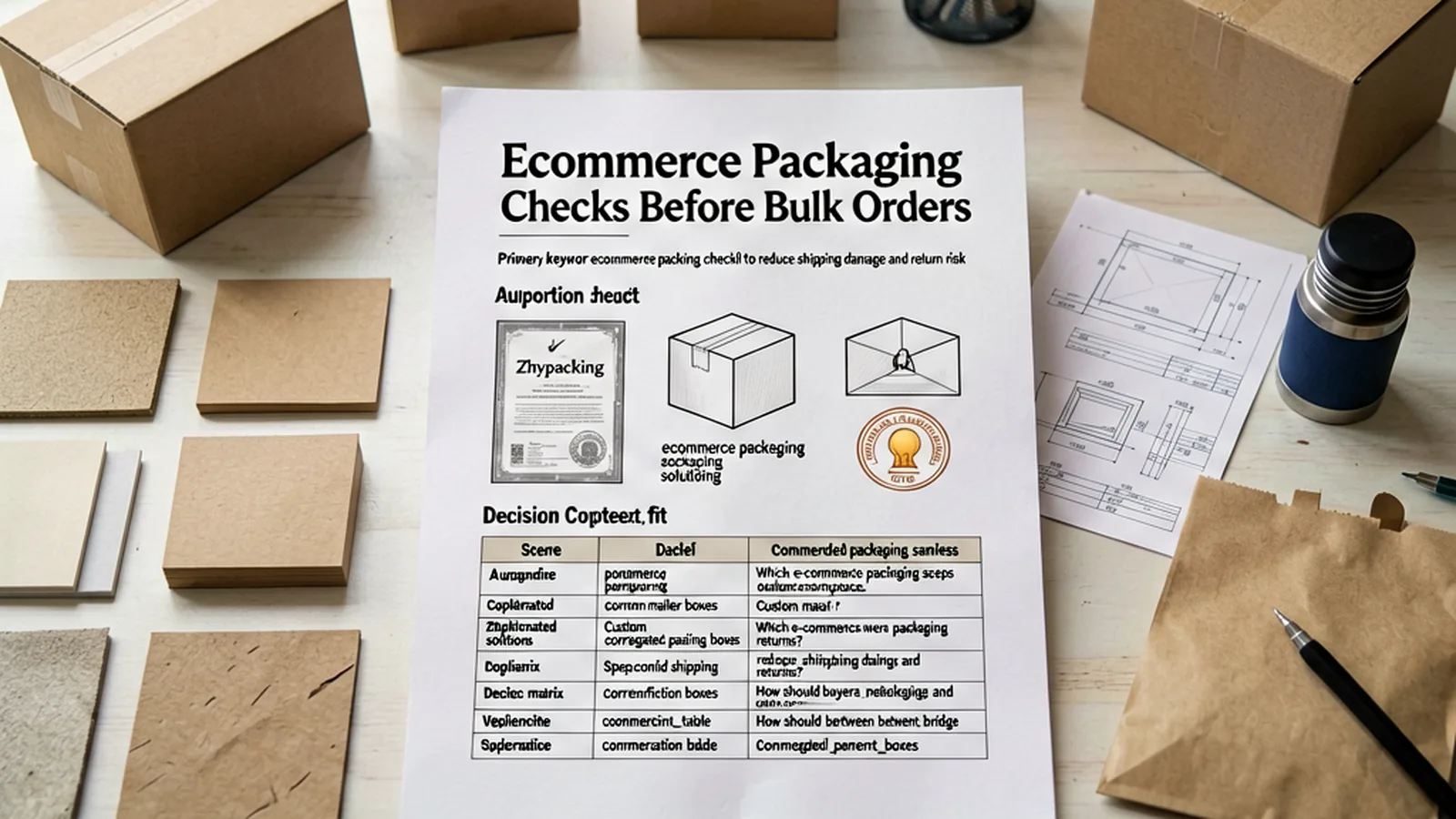
How Fit Choices Affect Timing and Approval
- Insert complexity custom foam or molded cavities add tooling and a proof stage of their own.
- Closure tuning magnet or hinge feel often needs a second sample round — plan it instead of discovering it.
- Approval chain name who signs structure, then finish, then fit; late signatures move the launch, not the factory.
- Audit trail supplier audit checklists like this 20-point jewelry packaging supplier audit exist because timing disputes usually trace back to undocumented steps.
Ask each shortlisted factory to state which fit checks happen at which stage, and keep a brief template like this jewelry packaging brief template beside the RFQ so nothing travels by memory. Ask for the tolerance behind each fit field — cavity depth, slot width, and closure force — as measurable parameters in the specification.
Use e-commerce packaging for related options.
Separate Confirmed Inputs From Supplier Assumptions
- Confirmed product dimensions, cavity specs, materials, closure standard, and quantities — all in writing.
- Assumed anything the supplier fills in by default: insert color, ribbon, protective film, packing method.
- Marked every assumption labeled in the RFQ with the owner who must confirm it.
- Launch-critical the subset that blocks the launch if it drifts; launch checklists like this jewelry packaging launch checklist treat them as gate items.
Two quotes are only comparable when their assumptions are identical. The labeled list is what makes the comparison honest.
Review packaging accessories before finalizing supplier questions and proof requests.
Reconcile the Sample With the Commercial Offer
- Fit evidence insert photos with the actual jewelry, plus any pull or closure test the supplier ran.
- Line items unit price, tooling, insert cost, and sample charges mapped to the spec fields.
- Terms minimum order per design, what starts production timing, and the rule for changes.
- Gap list any mismatch between sample and offer written down with an owner and a date.
Generic RFQ checklists, from sourcing bodies like this industrial RFQ checklist, use the same discipline: nothing passes reconciliation until every dimension in the offer traces to a measured value. The discipline exists to cut risk: an unreconciled gap today becomes a delivery dispute after bulk.
Use Zhypacking to align the sample and production handoff.
Conclusion: Award When Proof, Sample, and Offer Agree
Final approval rests on three records agreeing: the supplier’s fit evidence, the signed sample, and the itemized offer — all traced to the same measured specification. Where they disagree, keep sampling; where they agree, you have a basis for reorders too.
Use the checklist as your RFQ frame, and route the locked spec through the gift and PR packaging program when the box carries a gifting role.
Jewelry Packaging Fit FAQ
What should buyers confirm before ordering?
Exact product dimensions, weight, and presentation level from an approved piece — then cavity depth, insert shape, material data sheet, and closure standard per jewelry type.
How do we keep inserts consistent across SKUs?
Use an insert map: one line per SKU naming its cavity, retention method, and orientation. Ordering bulk insert sets is easier when the plan exists first — bulk buying guides like this jewelry boxes in bulk guide start there too.
Which fit tests should the supplier show?
Fit photos with the real product, closure cycle checks, and any transit simulation relevant to the channel. Custom-shape programs benefit from dedicated RFQ lists like this custom-shaped box RFQ checklist.
When should fit checks be re-run?
After any product change, material substitution, or closure redesign — and once at first production, because bulk inserts can drift from sample tooling.
RFQ handoff: For jewelry packaging fit, share product size, material, artwork, quantity, sample need, packing method, and deadline so the RFQ can be reviewed before sample approval. Send Specs for Review.

Ask a Packaging Question