

Apparel packaging quotes go sideways when brands only send a logo and a monthly order guess. Without SKU sizes, fold method, poly vs mailer choice, and return handling, every supplier invents a different package.
Build the quote pack around product dims, protection level, brand touchpoints, and reorder control so landed cost and unboxing stay aligned.
Direct answer: Send a folded L×W×H size map per SKU, not just a logo, because one oversize mailer for all items taxes every shipment with DIM weight. Pick poly, paper mailer, or box by crush risk and returns use, then test tear strips, spare stickers, and board scuff resistance on the real board. Approve bulk only when size family, outer format, and brand components pass on one revision set.
How this guide was prepared: The checklist connects apparel size families, protection, presentation, returns and shipping cost to RFQ evidence. FedEx’s dimensional-weight guidance explains why package volume can affect chargeable weight, while the ISTA procedure overview distinguishes different levels of product-package testing. Carrier rules, divisors and route hazards can change, so current carrier terms and the actual packed SKU set must be verified. Reviewed 24 August 2026.
| Order profile | Starting format | Trade-off | Validation |
|---|---|---|---|
| Single soft garment, low crush risk | Soft or paper mailer | Low cube but limited structure and presentation | Seal, tear, moisture exposure and return workflow check |
| Structured garment or multi-item order | Mailer box | More protection and brand area with greater cube | Fit, movement, scuff and route-appropriate packed test |
| Gift or launch kit | Box with tissue or insert | Higher assembly and component-control burden | Complete BOM, pack sequence, presentation and fulfilment trial |
When Apparel Needs More Than a Poly Mailer
Poly mailers win on cost and speed for many apparel SKUs. Step up to paper mailers, boxes, or branded tissue when returns presentation, giftability, or crush protection matter.
- Poly / soft mailer Tees, soft goods, low crush risk, high volume.
- Paper mailer / box Structured garments, multi-item kits, stronger brand unboxing.
- Inserts and tissue When fold presentation and card messaging are part of the product.
Pick the format from product risk and brand stage, not only from a competitor’s unboxing video.
Specs to Freeze Before the Apparel Packaging Quote
Send these fields with every serious apparel packaging RFQ:
| Field | What to write in the RFQ | Why suppliers need it |
|---|---|---|
| SKU size map | Folded L × W × H ranges by product type | Right-size mailers; avoid DIM waste |
| Weight & risk | Unit weight, hardware, shoes vs soft goods | Board/mailer strength and void fill |
| Outer format | Poly, paper mailer, box, or mixed by tier | Comparable quotes across formats |
| Brand elements | Print, sticker, tissue, card, tape — with file IDs | Print method and MOQ by component |
| Returns | Reuse expectation, open method, spare labels | Structure and tear-strip choices |
| Volumes | Monthly and launch quantities by SKU family | MOQ, price breaks, inventory plan |
A logo PNG without a size map produces decorative quotes, not operational packaging.
Use packaging dieline and custom packaging specs to align the related specifications and RFQ inputs.
RFQ checkpoint
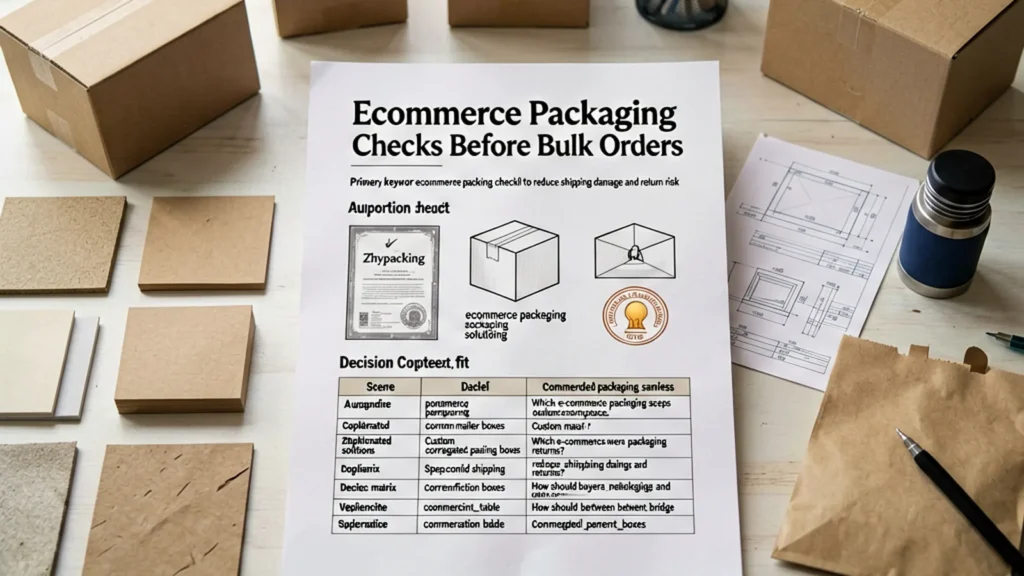
Match the solution route to the buyer scenario, proof requirement, and quote step before sampling this order.
How Box, Bag, and Insert Choices Hit Landed Cost
Dimensional weight, multi-component kits, and returns shipping often dominate unit print cost. Right-sizing and reducing unnecessary rigid components usually save more than shaving ink coverage.
- One oversize mailer for all SKUs Simple ops, higher ship cost.
- Size family (S/M/L) Better DIM control; needs pack rules.
- Tissue + card + mailer Brand lift; more SKUs and QC points.
Ask suppliers to price the full pack-out, not only the outer shell.
See custom retail packaging for how box, bag, and insert choices hit landed cost.
What Brands Get Wrong on Apparel Packaging RFQs
- Quoting only the hero SKU while a large share of volume is a different fold size.
- Approving print on white stock then running kraft without a new sample.
- Ignoring return rate and open-method damage on branded faces.
- Mixing gift-box expectations with mailer budgets on the same PO.
- No artwork revision control across sticker, tissue, and outer print.
Fix the RFQ inputs before comparing unit prices line by line.
Material and specification fit
For apparel ecommerce packaging, turn the material and specification choices into a written buyer record before the supplier prices, samples, or schedules production.
MOQ, cost structure, and lead time
For apparel ecommerce packaging, use MOQ, cost structure, and lead time to connect the buyer requirement, quote input, supplier proof, sample record, and next RFQ follow-up.
Supplier reliability and quality checks
For apparel ecommerce packaging, keep supplier reliability and quality checks tied to the RFQ so the shortlist compares supplier behavior, not only product range or unit price.
Use packaging accessories to align the related specifications and RFQ inputs.
Move the Checks Into the RFQ
RFQ should include SKU size map, weights, outer format by tier, brand component list with file revision IDs, volumes, return handling, and sample kit scope.
For ecommerce programs that also use retail gift packaging, keep both routes under the same ecommerce packaging solution path so materials and brand color stay aligned.
Decision criteria to confirm
For apparel ecommerce packaging, carry the buyer requirement, quote input, supplier proof, sample record, and next RFQ follow-up into the RFQ and production handoff.
RFQ details to send
For apparel ecommerce packaging, turn the RFQ details into a written buyer record before the supplier prices, samples, or schedules production.
Production handoff details
For apparel ecommerce packaging, carry the buyer requirement, quote input, supplier proof, sample record, and next RFQ follow-up into the RFQ and production handoff.
When to Approve Bulk
Approve bulk when size family, outer format, brand components, and ship performance pass on the same revision set. If pack-out time or DIM cost is still a guess, keep testing with real SKUs.
Request a packaging review with product photos, fold sizes, and monthly volume mix.
See e-commerce packaging for when to approve bulk.
Apparel Packaging Quote FAQ
Should every apparel order use a custom printed mailer?
No. Many programs win with a quality unprinted mailer plus controlled tissue, sticker, or card — then upgrade print when volume justifies plates or digital runs.
How do I quote mixed SKU sizes?
Provide a size map and volume mix. One blended “average size” quote usually fails in real pack-out.
What belongs in a first sample kit?
Outer format candidates, fold examples for top SKUs, brand elements on production materials, and a simple ship check for hardware or dense items.
How do returns affect packaging choice?
If customers must reopen and reseal, tear strips, spare stickers, and board scuff resistance matter as much as the first unboxing photo.
See Zhypacking for apparel packaging quote faq.
RFQ handoff: For apparel ecommerce packaging fit, share product size, material, artwork, quantity, sample need, packing method, and deadline so the RFQ can be reviewed before sample approval. Send Specs for Review.

Ask a Packaging Question