

A shipping box cannot be specified by a generic “strong enough” claim or one board grade. Compression performance depends on the packed product, carton dimensions, board construction, closures, stacking time, humidity exposure, pallet pattern and distribution route.
Quick buyer answer: Send the supplier the gross packed weight, internal and external carton dimensions, product support, units per carton, stacking pattern, maximum stack height and duration, storage conditions and route. Ask for the proposed board and box construction plus a named compression or distribution-test method. Approve the complete packed system against written failure criteria, not an empty-box sample alone.
How this guide was prepared: The checklist maps RFQ inputs to compression evidence and route-specific validation. ASTM D642-25 covers compression testing of shipping containers, components and unit loads; the ISTA procedure overview explains that screening and simulation procedures serve different purposes. Neither supplies a universal pass value for every product or route. The buyer, supplier and test provider must define conditioning, loading, failure criteria and applicability for the actual pack. Reviewed 24 August 2026.
A comparable supplier response ties the proposed box construction to the same packed weight, geometry, stack and route assumptions. If those assumptions differ, the compression results and unit prices are not directly comparable.
What compression strength means in a shipping box RFQ
Compression resistance is evidence from a defined test setup, not a marketing adjective. A useful report identifies the specimen, conditioning, platen or load method, orientation, peak or sustained load, observed failure and acceptance rule. Buyers should also record whether the result represents an empty carton, a packed carton or a unit load.
Product weight and stacking assumptions
State the gross weight per carton, how the product contacts the panels and whether inner packs or dividers help carry vertical load. Also state the intended stack height and duration. A rigid product that supports the top panel behaves differently from a loose or fragile product that leaves the carton walls to carry most of the load.
Board structure and box style variables
Ask the supplier to state the corrugated board combination, flute, box style, joint and closure rather than returning only a generic grade name. Compare the tested sample with that construction and the approved dieline; a size or joint change can alter performance even if the material description appears unchanged.
Review Shipping Box vs Retail Packaging before sending the RFQ.
Hold approval when a supplier cannot connect its recommendation to the stated product, stack and route, or when a test report describes a different carton construction. Resolve the mismatch by correcting the RFQ, retesting the production-intent pack or documenting why the evidence is applicable.
Which logistics details change strength requirements
Compression strength changes when the packed product, carton geometry, stacking plan, storage condition, and route handling change. A quote that only says “strong box” is not enough for production approval.
| RFQ input | What to specify | Why it changes strength | Quote or sample impact | approval risk if missed | Buyer check |
|---|---|---|---|---|---|
| Product and packed weight | Unit weight, units per carton, inner packing | Load transfer changes with product density and movement | May change board grade, flute, insert, or carton size | Under-spec carton may fail under real load or over-spec carton may inflate cost. | Test the packed product, not an empty box |
| Carton dimensions | Length, width, height, orientation, tolerance | Tall or narrow boxes can lose stacking stability faster | May require size adjustment or material upgrade | Wrong geometry can reduce stacking stability even when material looks adequate. | Confirm final dimensions before sample approval |
| Stacking and storage | Pallet pattern, stack height, storage time, humidity exposure | Longer compression load and moisture can reduce performance | May affect test target, coating, or packing method | Storage and route assumptions can make the approved sample weaker than expected in use. | Ask how the supplier interprets the route condition |
The RFQ should also cover branding and surface treatment; approve the final printed or finished sample when strength matters.
Palletizing, warehouse storage, and courier handling
Ask the supplier to recommend material and sample checks against the stated route. If the route changes later, treat the strength decision as a change-control item rather than a cosmetic edit.
Use the table above to compare supplier answers against the same approval criteria. The buyer should turn the selected rows into written RFQ lines: final structure, material, artwork, finish, packing, sample owner, and supplier evidence. If a row cannot be confirmed before sampling, keep it out of the bulk order decision until cost, lead time, and QC impact are clarified.
Inner packaging and product movement risk
Connect inner packaging and product movement risk to the buyer requirement, quote input, supplier proof, sample record, and next RFQ follow-up.
RFQ checkpoint
Check the product route for sizes, structures, materials, finishes, and RFQ details before sampling.
What proof buyers should request before approving samples
Use this table to turn proof requests into specific RFQ lines, sample checks, approval risks, and supplier follow-up questions.
| Specification | Quality control | Verification method | Risk to avoid | Buyer action |
|---|---|---|---|---|
| Finish or surface effect | Check finish or surface effect against the approved sample and written spec. | Verify Finish or surface effect against the approved sample and written specification. | If Finish or surface effect is not documented, quote, sample, or production approval can drift. | Record the approved Finish or surface effect requirement in the RFQ and sample file. |
| Artwork or logo file | Check artwork or logo file against the approved sample and written spec. | Verify Artwork or logo file against the approved sample and written specification. | If Artwork or logo file is not documented, quote, sample, or production approval can drift. | Record the approved Artwork or logo file requirement in the RFQ and sample file. |
| Packing format | Check packing format against the approved sample and written spec. | Verify Packing format against the approved sample and written specification. | If Packing format is not documented, quote, sample, or production approval can drift. | Record the approved Packing format requirement in the RFQ and sample file. |
Sample crush, fit, and packing checks
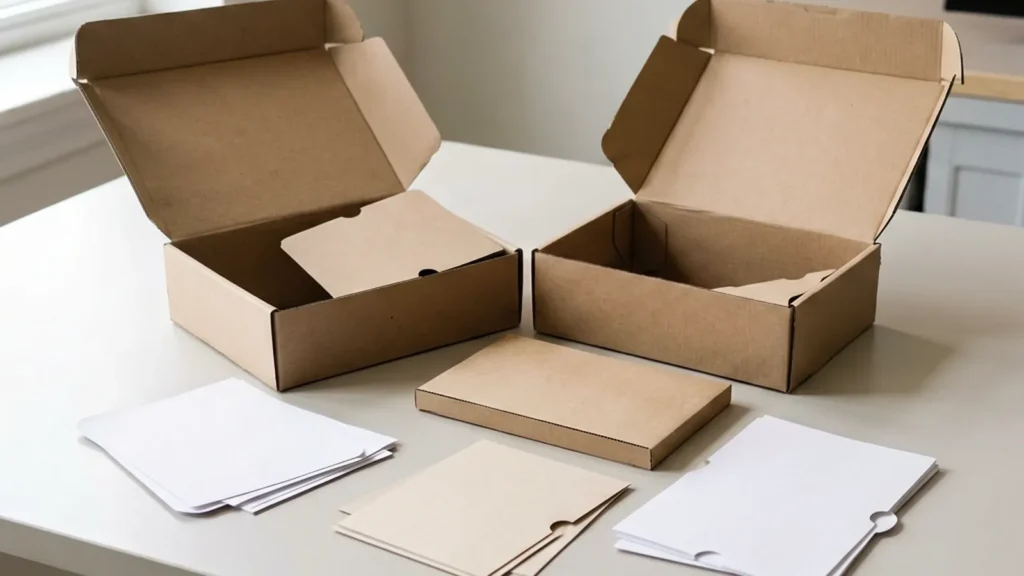
Check the physical sample against the stated requirement, dieline, material specification, and product fit; record the accepted tolerance for production QC.
Supplier questions for repeat orders
Move the approved sample into a production handoff that lists the final files, material, structure, print, finish, packing, QC checkpoints, and schedule basis.
Review custom packaging specification support before sending the RFQ.
Questions to confirm before ordering:
- Sample crush, fit, and packing checks Record the specification, owner, and approval status in writing. Request proof in the RFQ, then approve, revise, or hold the order.
- Supplier questions for repeat orders Record the specification, owner, and approval status in writing. Request proof in the RFQ, then approve, revise, or hold the order.
- Specification details Record the specification, owner, and approval status in writing. Request proof in the RFQ, then approve, revise, or hold the order.
Shipping box strength RFQ checklist
- Specs to prepare Record the specification, owner, and approval status in writing, because missing proof can create quality defects, approval disputes, or delivery problems. Request proof in the RFQ, then approve, revise, or hold the order.
- Risks to verify before production Record the specification, owner, and approval status in writing, because missing proof can create quality defects, approval disputes, or delivery problems. Request proof in the RFQ, then approve, revise, or hold the order.
Specs to prepare
Add these specs to the RFQ with the artwork file, finish target, board choice, and packing notes so the sample is judged against one buyer-approved record.
Risks to verify before production
Move the approved sample into a production handoff that lists the final files, material, structure, print, finish, packing, QC checkpoints, and schedule basis.
Review ecommerce packaging solutions packaging path before sending the RFQ.
In conclusion
Compression strength is not a standalone number to request after the quote. It is the result of product weight, box dimensions, board choice, stacking pattern, pallet plan, storage condition, route handling, and the buyer’s damage tolerance.
For a practical RFQ, start from the paper box size options and attach the product weight, packed unit count, carton dimensions, pallet height, expected stacking time, and whether the box needs printed retail presentation. If the supplier cannot explain how those inputs affect the sample, the strength requirement is still under-briefed.
- Request the board/flute recommendation, sample test basis, and pass/fail criteria in writing.
- Confirm whether print coverage, coatings, humidity exposure, or long storage may change performance.
- Approve samples against the real packing method before treating the quote as production-ready.
For the broader package-system decision, review Shipping Box vs Retail Packaging before locking the compression brief. That upstream guide helps decide whether the strength requirement belongs in the shipper, retail box, insert, or the complete packaging system.
The main approval risk is approving a carton that passes a desk review but fails under the actual packing, stacking, storage, or transport condition. Keep the route assumption and sample proof together in the approval record.
FAQ
What information does a supplier need to recommend shipping box strength?
Provide product weight, packed quantity, box dimensions, pallet pattern, stacking height, storage time, route handling, and whether humidity or print coverage could affect the board.
Should buyers ask for a compression number first?
It is better to brief the use case first. A number without product weight, stacking, and route assumptions can lead to a quote that looks precise but does not match real handling risk.
What sample or proof checks reduce risk for shipping box compression strength?
Check the approved sample, board or flute recommendation, packed product test, pallet or stacking assumption, and the QC record the supplier can provide after production.
Which quote terms should buyers compare before RFQ?
Compare material grade, carton dimensions, printed or coated surface, test requirement, sample scope, packing method, freight assumptions, and whether a change in route requires a new check.
Ask a Packaging Question