
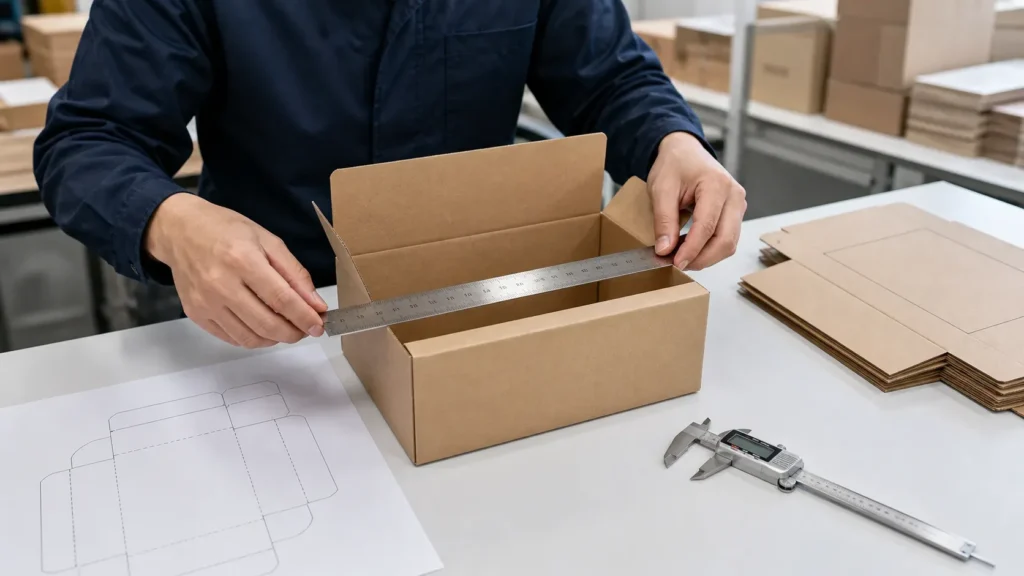
Box dimensions are written Length × Width × Height (or Depth) in that order, measured inside the box when you are fitting a product and outside the box when you are planning shipping — and the single most expensive mistake in custom packaging quotes is mixing those two conventions without saying which one you meant.
From the factory side, dimensions are the first fields we check in any RFQ, because a quote built on the wrong convention cannot be compared with other quotes — it is a different box at a different price.
The failure pattern is common enough to have a shape: three suppliers quote “the same” box at three different prices, the sample arrives a size off, and the argument about whose numbers were right starts after the money is spent. Every version of that story traces back to one of five gaps this guide closes — order unstated, inside/outside mixed, measured wrong, written wrong, or freight assumed.
This guide covers the order convention, inside vs outside, how to measure, how to write dimensions into an RFQ, and how dimensions move freight cost — so your quote arrives on the same basis as every supplier you are comparing.
What Order Do Box Dimensions Go In?
The industry-standard order is Length × Width × Height (or Depth): length is the longest side of the opening, width the shorter side of the opening, height (or depth) the distance from the opening to the base.
Two complications make this convention unreliable without confirmation:
- Height vs depth. Retail boxes stand on their depth; shipping boxes stand on their height. The same carton is described differently depending on which face someone calls the bottom.
- Supplier variations. Some suppliers quote Width × Depth × Height, some Length × Width × Depth, and packaging engineering drawings may use internal panel dimensions instead of finished dimensions at all.
The working rule is not “remember the one true order” — it is state the order you are using, next to the numbers, in the RFQ: “90 × 50 × 130 mm (W × D × H)”. A supplier who sees the order written down can compare quotes on the same basis; a supplier who guesses the order is quoting a different box.
When the order is stated, the table below is just translation — one physical carton, three written conventions, the same dieline. When the order is omitted, the reader assumes a convention, and that is where a different box appears: a carton quoted as 90 × 50 × 130 and one quoted as 50 × 90 × 130 hold the same volume, but their openings face different directions, their flaps fold from different panels, and their dielines are different drawings. Volume being identical is exactly what makes the mistake silent — every number is “correct”, and the box is still wrong.
The same box described under three conventions, side by side:
| Convention | Written as | What the reader assumes |
|---|---|---|
| L × W × H (opening first) | 90 × 50 × 130 mm | Longest opening side first, standing height last |
| W × D × H (supplier engineering) | 50 × 90 × 130 mm | Width of the opening, then depth, then standing height |
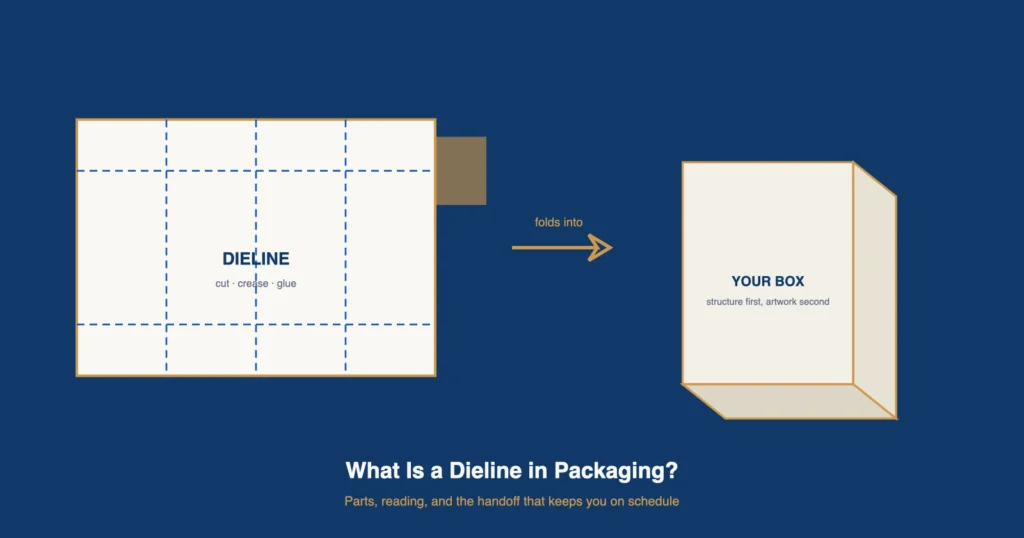
| Panel dimensions (drawing style) | 90 × 130 + 50 × 130 panels | Face panel dimensions straight off the dieline |
All three describe the same 90 × 50 × 130 mm carton — and a buyer reading one column against a quote written in another will conclude the boxes differ. The three-line fix: state your order in brackets, quote the numbers with units, and keep one line per size so nothing is inferred from position.
Next action: write your three numbers with the order in brackets, and ask each supplier to confirm the order in their quotation.
Inside vs Outside Dimensions
This is the question that decides whether the product fits — and it has a strict rule:
- Inside dimensions decide fit. The product must clear the inner walls, inserts, and any wrap. Inside dimensions are measured from the inner faces of the board, at the base of the box.
- Outside dimensions decide logistics. Outer dimensions are what the shipping carton, the shelf plan, and the freight calculation see — they include board caliper on every wall.
Board caliper sits between the two: a box made from 1.5 mm board has outer dimensions roughly 3 mm larger than inner dimensions on each axis (two walls per axis). For thin folding carton board the difference is small but real; for rigid or corrugated constructions it is decisive.
Which one does your RFQ need? Both, with the inside dimensions as the fit-critical numbers. The split of responsibility:
| Decisión | Which dimension decides it | Who states it |
|---|---|---|
| Does the product fit? | Inside dimensions + clearance | Buyer measures the product; supplier confirms feasibility |
| Does the insert hold? | Insert outer dims vs box inner cavity | Buyer states insert; supplier designs the cavity |
| Will it ship in the planned master carton? | Outside dimensions | Supplier states from proposed board |
| Does it fit the retail shelf plan? | Outside dimensions | Buyer checks against the shelf spec |
Each row is a different decision answered by a different number — which is why “the box is 90 × 50 × 130” is never a complete answer on its own. State the inside dimensions as the fit specification and let the supplier derive the outer dimensions from the board — then compare outer dimensions across quotes for freight. The dimension mistakes that change price are covered in depth in the box measurement mistakes guide; the RFQ-ready input format is in the box dimensions RFQ checks.
A worked example shows why the gap matters. A carton with a 90 mm inside width, built from 0.5 mm folding carton board, has an outside width of roughly 91 mm (two walls). The same inside width in a rigid construction with 1.5 mm greyboard walls has an outside width of 93 mm — and 2 mm on the width plus 2 mm on the depth is enough to change the master carton count and the shelf plan.
Read in the buyer’s direction: start from the product, add clearance for wrap and movement, treat the result as the inside-dimension target, and ask the supplier to state the resulting outside dimensions for their proposed board. The caliper bridge between the two is the supplier’s engineering call — verify it on the sample, because it is not visible in either number.
Next action: measure inside dimensions for fit, ask the supplier to state outside dimensions for freight, and never let one number stand in for the other.
How to Measure a Box Correctly
Measure a folded box on a flat surface, with the opening facing up. The steps:

- Measure the opening. Length across the longest side of the opening, width across the shorter side, both at the base of the box — not at the top lip, where tucks or flares can add millimeters.
- Measure the height (or depth). From the base surface to the top edge of the wall — for a tuck carton, to the top of the wall, not to the tip of the tuck flap.
- Decide inside or outside. Tape on the inside faces measures inside dimensions; tape wrapped around the outside measures outside dimensions. Note which you did.
- Record board caliper. If you have a folded sample, note the board thickness — it explains the inside-to-outside difference and lets the supplier verify their caliper assumption.
- Photograph the tape positions. A photo of where each measurement was taken prevents drift when three people reconstruct the box from notes.
Measure the product the same way — outer dimensions at its largest point, including caps, handles, labels, or wrap. A product that measures 88 mm but ships in a 2 mm sleeve needs a 90 mm+ inner clearance, not an 88 mm box.
Measuring the product has its own trap: products are not rectangles. A bottle’s largest point may be its shoulder; a boxed set’s largest point may be the ribbon bow. Measure the product at its largest point across each of the three axes, add the clearance your fragility level requires (a scuff-proof cosmetic set needs more than a poly-wrapped spare part), and record that as the inside-dimension target.
For an existing box you want reproduced: measure it folded, measure it flat if you can disassemble a glue seam, and note both. A folded measurement tells the supplier what you have; a flat measurement tells them what the die produced — the two together let them verify their caliper and grain assumptions against a real sample instead of guessing from a photo.
Next action: measure box and product with the five steps, and attach the photo set to the RFQ.
How to Write Dimensions in an RFQ
The written format is what turns measurements into a comparable quote. One line, in this shape:
Inside dimensions: 90 × 50 × 130 mm (W × D × H), tolerance ±1 mm. Quantity: 2,000 pcs. Board: white card, per supplier recommendation for retail print.
The elements that make a dimension line quote-ready:
- The order, stated in brackets — never bare numbers.
- Units on every number — mm or inches, never mixed.
- Inside/outside labeled — the fit-critical convention named.
- Tolerance stated — even a simple ±1 mm tells the supplier how exact the fit decision must be.
- Quantity per size — a project-level minimum of 200 pcs per size applies to folding cartons, and one order can mix sizes and styles at their minimums.
- Units consistent across the whole RFQ — mm everywhere or inches everywhere; a mixed RFQ is how 90 mm becomes 90 inches on one line and 9.0 cm on another.
- Decimal precision that matches reality — dimensions to the nearest millimeter are production-real; dimensions to two decimals imply a precision the cutting table does not carry and invite false-precision quotes.
An illustration of the wrong way: “box is about 9 by 5 by 13”. Three numbers, no units, no order, no inside/outside label, no tolerance — the quote comes back with assumptions instead of a price, or worse, a price built on a different box.
For a multi-size order, one block per size keeps every quote line on the same basis:
Size A: inside 90 × 50 × 130 mm (W × D × H), tolerance ±1 mm — 1,200 pcs
Size B: inside 70 × 40 × 100 mm (W × D × H), tolerance ±1 mm — 800 pcs
Board: white card per supplier recommendation. Print: CMYK outside, matte lamination. Both sizes mix in one order against the per-size minimums.
Both sizes written this way give the supplier everything needed to quote each line and to state the combined production plan — and give you line-by-line quotes that compare across suppliers without any order guessing.
Next action: write your dimension line in the format above and paste it into the RFQ — then read it back and ask “could a stranger build the right box from this line alone?”
How Dimensions Affect Shipping Cost
Dimensions move freight through two mechanisms:
- Flat sheet packing efficiency. Your dieline is a flat sheet larger than the folded box — folding spends board on walls and tucks. A structure that uses board less efficiently (more glue area, deeper tucks, an auto-lock base) needs a bigger flat sheet per box, which means fewer blanks per corrugated master carton — and freight is quoted per carton, so the difference shows up per unit, every order.
- Dimensional weight. Carriers charge on the greater of actual weight and volumetric weight (outer dimensions ÷ a carrier divisor). Outer dimensions therefore set the floor of your per-unit freight.
A worked illustration of dimensional weight: a shipping carton measuring 40 × 30 × 30 cm has a volume of 36,000 cm³. Divide by a carrier’s dimensional divisor (commonly 5,000 for express services) and the chargeable weight is 7.2 kg — even if the carton weighs 4 kg on the scale. The chargeable number is the greater of the two. A box whose outer dimensions grow by 2 cm per side moves the divisor math and the master-carton count at the same time, which is why outer dimensions belong in every quote comparison even though they are not the fit numbers.
You do not need a calculator to manage this — you need the outer dimensions stated per quote, so the master-carton math can be compared supplier against supplier on the same basis. Exact carrier rates come from the carrier; the buyer-side verification is simply “outer dimensions stated, per unit carton count stated.”
Next action: ask each supplier to state outer dimensions and blanks-per-master-carton in the quote, and compare freight on the same basis.
Dimension Mistakes That Change the Quote
Three headline mistakes bring buyers to this topic — each has a full deep-dive already on site:
- Enviar las dimensiones del producto como dimensiones de la caja terminada. — product clearance, board caliper, and insert space all missing, and the quote comes back understated because it is pricing a smaller box than you need. The full failure list: box measurement mistakes that change quotes.
- Measuring the wrong box assumption — retail carton, mailer, and shipping box measure differently; mixing their conventions changes fit and freight at once, and the error survives every spreadsheet because each line is internally consistent.
- Dimensions drifting between quote and sample — the quote assumed one set, the sample was built to another; the approval then ratifies a box nobody quoted. The written-record fix: box dimensions RFQ checks.
Next action: if any of the three describes your current RFQ, fix it there before sending — the deep-dives carry the full checklists.
Preguntas frecuentes sobre dimensiones de cajas
Are box dimensions inside or outside?
Both exist and both matter: inside dimensions are the fit-critical numbers (product clearance), outside dimensions are the logistics numbers (freight, shelf). State inside dimensions in the RFQ and let the supplier derive outer dimensions from the board.
What comes first, length or width?
Industry convention is Length × Width × Height, but supplier variations exist. The safe practice is stating the order in brackets next to your numbers and asking the supplier to confirm theirs in the quotation.
Is there a box dimensions calculator I can use?
For a quick sanity check, multiply your product’s largest-point dimensions plus clearance and compare against any box you already have on hand — a household box that fits with room to spare is a live confirmation of your inside-dimension target. For custom orders, the reliable “calculator” is the supplier’s proposed dieline against your stated inside dimensions: a spreadsheet cannot see board caliper, glue tabs, tuck depth, or product clearance, and those are exactly the values that decide whether the box works.
How much tolerance should I allow?
For folding carton fit decisions, ±1 mm on inside dimensions is a workable starting tolerance; tighter than that, and normal production tolerance consumes your clearance. Two-sided products (a lid and a base, a box and its insert) deserve an explicit tolerance pair — state the insert tolerance tighter than the outer box tolerance so the stack still assembles. State the tolerance and let the supplier confirm feasibility against the board and structure.
Is a carton the same as a box?
In everyday use they overlap; in packaging English, “carton” usually means folded paperboard packaging (folding cartons, mailer cartons) and “box” is broader — it can also mean rigid boxes and corrugated shipping boxes. In an RFQ, name the structure family instead of relying on either word.
How do I know if a dimension on a drawing is inside or outside?
Engineering drawings usually dimension each panel from its finished folded face, which reads as inside dimensions panel by panel — but the convention is not universal. The safe method: ask the supplier to state which convention the drawing uses, and check one dimension against the physical box you have. One measurement settles it.
Do I need different dimensions for a box with inserts?
Yes — the insert has its own inside dimensions inside the box’s inside dimensions. State the insert’s outer dimensions and material, and the insert’s position (glued to the base, sitting loose, telescoping), so the supplier can set the box’s inner clearance to hold the insert without rattling while still fitting your product in its cavity.
Send Dimensions That Get a Same-Basis Quote
A same-basis quote needs four inputs: inside dimensions with tolerance and the stated order, quantity per size, board preference, and print and finish direction. Send them to the custom folding cartons page for carton structures, or the cajas de correo personalizadas page for e-commerce mailers — and the quotes you compare will be quoting the same box.
If the dimensions are still estimates, send them labeled as estimates — a quote on stated assumptions with a stated sample checkpoint is a better planning tool than a precise-looking number nobody can trace. The suppliers who respond by confirming your order convention and stating their outer dimensions are the ones you can compare; the ones who just repeat your numbers back are quoting assumptions of their own.
Send your specs to get a same-basis quote from our Xiamen factory.
Hacer una pregunta sobre empaques